'Must Be Corrected': A Leaked University Document Reveals China's Plan to Erase the Mongolian Language
Reeducted
By Soyonbo Borjigin
|
Author Bio Soyonbo Borjigin is a journalist and author from Southern Mongolia. His work focuses extensively on ethnic policies, language rights, and human-interest stories in China, offering critical insights into the region's socio-political shifts. |
The original Chinese document is available here. A full English translation with annotations is available here.
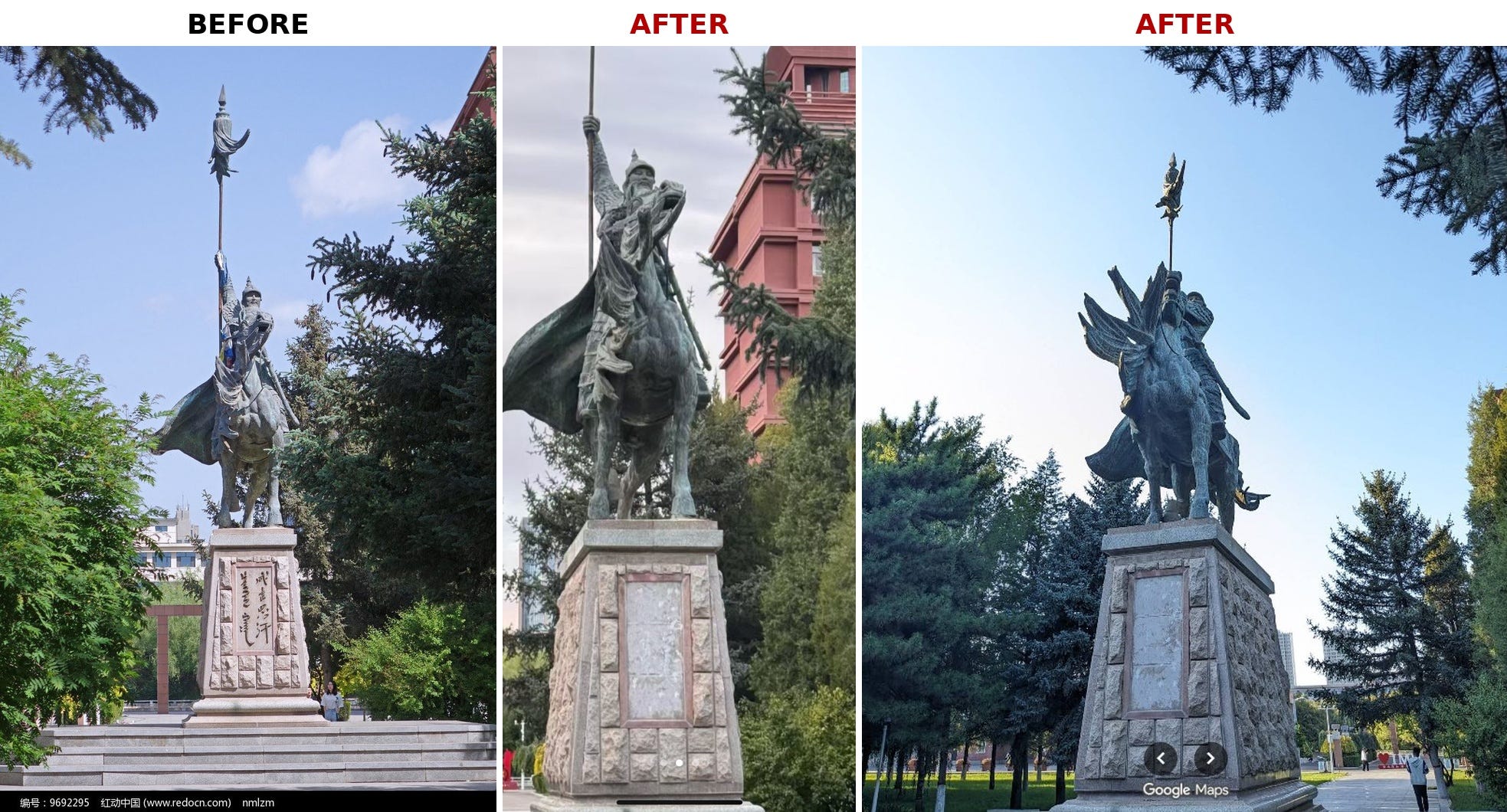
There is a statue of Genghis Khan at Inner Mongolia University. For decades, the statue carried his name in traditional Mongolian script. At some point in 2022, the inscription was removed. Leaving a blank scar. I know because I saved the Google Maps street-view images before they, too, were deleted.
Why would a university erase the Mongolian script from a Mongolian historical figure on a campus in Inner Mongolia Autonomous Region? The answer is in a 16-page internal Party document that was never meant to be seen outside the university.
The document is dated December 31, 2021, the last day of the year. It was approved by the 72nd meeting of the university’s Party committee and stamped “Internal Document — Strictly Prohibited from External Distribution” (内部文件,严禁外传). The title is “Implementation Plan for Forging of a Strong Sense of Community for the Chinese Nation as the Main Line to Advance the High-Quality Development of the Party’s Ethnic Work in the New Era” (内蒙古大学关于以铸牢中华民族共同体意识为主线推进新时代党的民族工作高质量发展的实施方案).
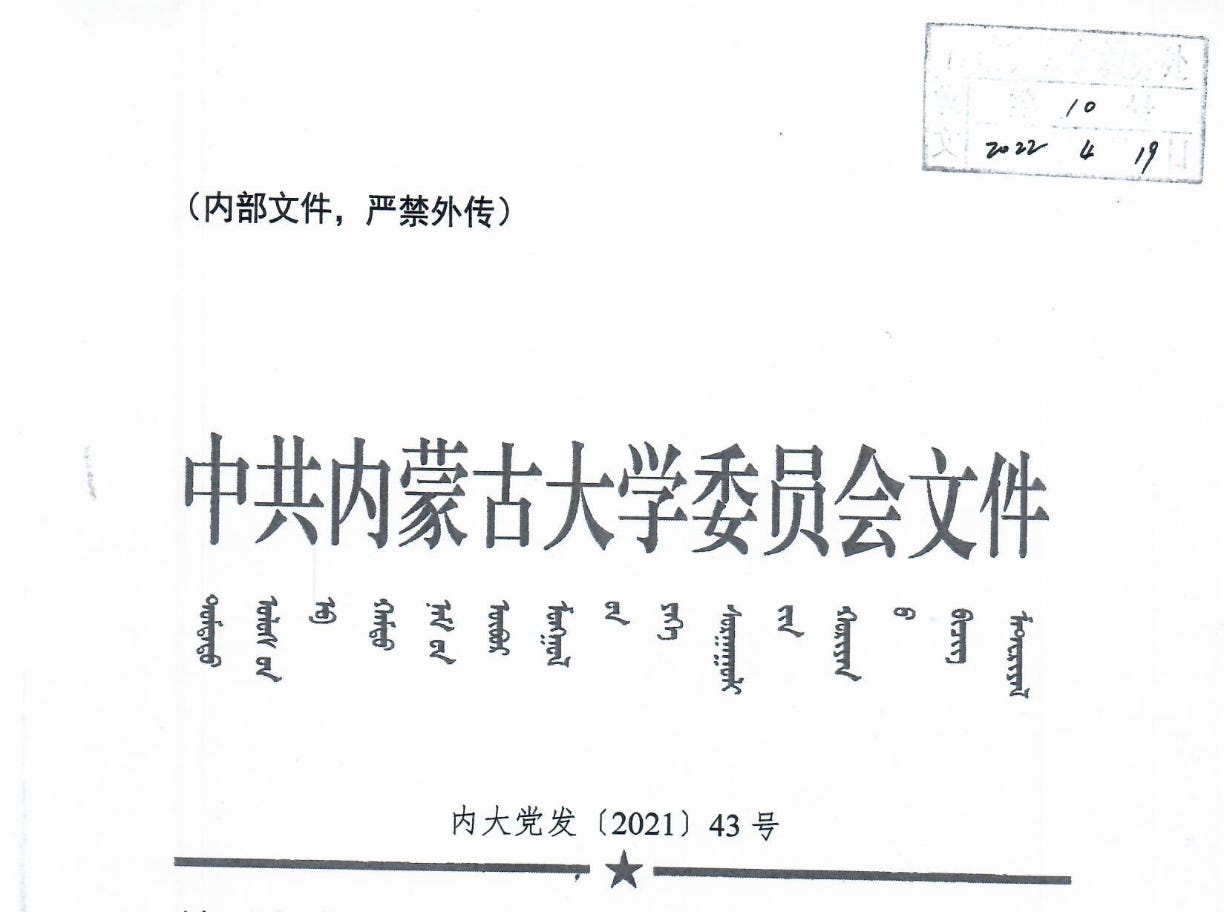
In 16 pages and 19 directives, it instructs, with chilling bureaucratic precision, how to remove the Mongolian language from classrooms, theses, and campus; how to disperse Mongolian students into mixed-ethnicity dormitories; how to survey the religious beliefs of faculty and students; and how to monitor their online activity for signs of what the Party calls “separatism.”
In September 2020, Beijing ordered schools across Inner Mongolia Autonomous Region to replace Mongolian-medium instruction with Mandarin Chinese textbooks. Mongolian students and parents took to the streets in the largest protests the region had seen in decades. The authorities crushed the movement within weeks through surveillance, blacklisting, expulsion, and arrest, then launched a systematic campaign of ideological re-education across the region’s schools and universities. Professor James Leibold has documented this crackdown in detail.
Document No. 43 is where that campaign reaches the ground. Its preamble cites three upstream directives from the Party Central Committee, the Inner Mongolia regional government, and the regional education leadership group. The document translates them into enforceable orders for Inner Mongolia University.
Language
The document never uses the word “Mongolian.” It also never uses the word “Mandarin.” Every reference to language is filtered through the official euphemism 国家通用语言文字, which translates to “the standard national spoken and written language.” This means Mandarin Chinese. This is intentional. By avoiding the name of either language, the document makes it possible to order the elimination of one without ever acknowledging it exists.
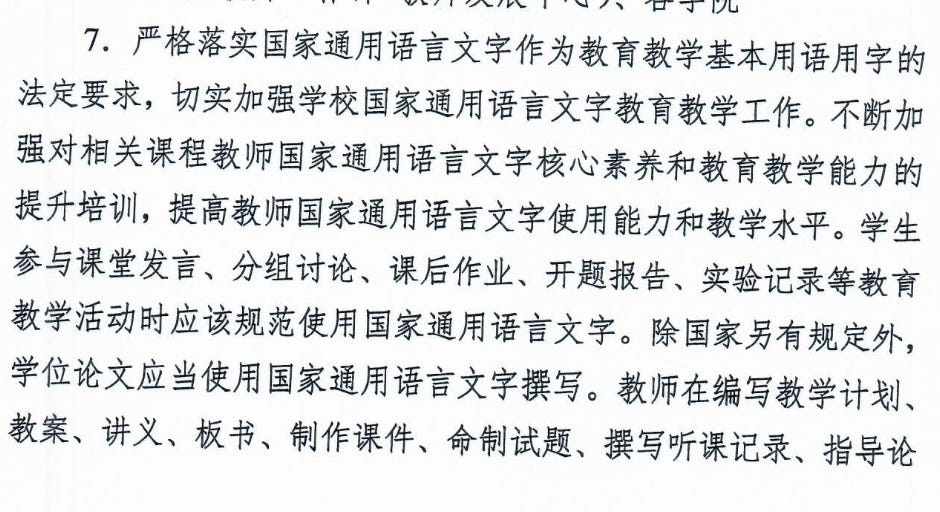
Item 7 of the document lists every academic activity that must be conducted in "the standard national spoken and written language": student classroom participation, group discussions, homework, thesis proposals, laboratory records, degree theses, lesson plans, lecture notes, board writing, courseware, examination questions, classroom observation records, thesis supervision comments, internship reports, and research project applications. The list covers virtually every form of written and spoken communication at the university. The most consequential line is this: "Except where the state has other provisions, degree theses shall be written using the standard national spoken and written language." Inner Mongolia University is home to the School of Mongolian Studies (蒙古学学院), one of the most important centers of Mongolian-language scholarship in the world. This provision orders that scholarship to be conducted in Mandarin Chinese.
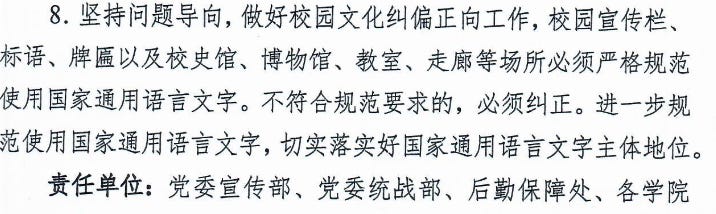
Item 8 turns to the physical campus. It orders that "campus bulletin boards, slogans, plaques, and locations including the university history museum, ethnic museum, classrooms, and corridors must strictly and standardly use the standard national spoken and written language" (校园宣传栏、标语、牌匾以及校史馆、博物馆、教室、走廊等场所必须严格规范使用国家通用语言文字). Anything that does not conform "must be corrected" (必须纠正).
A statue bearing Mongolian script on a campus would not conform to this standard. I believe this is why the inscription was removed.
Item 5 calls for "unswervingly promoting the use of nationally standardized textbooks" (坚定不移推行使用国家统编教材). These are the same Mandarin-language textbooks whose introduction into primary and secondary schools triggered the 2020 protests. This document extends that policy into higher education.
Curriculum
Item 3 requires the university to establish a compulsory course titled "Introduction to Forging a Strong Sense of Community for the Chinese Nation" (铸牢中华民族共同体意识概论). Every student must take it regardless of major. It joins the existing roster of mandatory ideological courses that all Chinese university students must complete, such as Marxism and Xi Jinping Thought. The word "forging" (铸牢) is worth noting. It literally means to melt in metal and to make firm. What is being cast is a specific consciousness: identification with the "Chinese nation" (中华民族) as a unified entity that subsumes all 56 officially recognized distinct identities. The document states this plainly in its goals section: the university must educate students to understand "the relationship between commonality and difference" and to "improve ethnic work in the direction of enhancing commonality" (按照增进共同性的方向).
Item 19 controls what students read. It establishes a triple-review standard for all academic materials: "all textbooks compiled must be reviewed, all translations must be reviewed, all selections must be reviewed" (凡编必审、凡翻必审、凡选必审). Philosophy and social science textbooks are singled out for special review of their "ideological character." Foreign textbooks receive the same scrutiny. The translation of minority-language textbooks is subjected to what the document calls "strict standardization." Any textbook whose "political stance, value orientation, or ideological character" does not conform to state requirements must be "resolutely and immediately discontinued" (坚决、及时停止使用).
The phrase "all translations must be reviewed" (凡翻必审) has a specific weight. In April 2021, eight months before this document was issued, Chinese authorities sentenced Sattar Sawut, the former head of Xinjiang's education department, to death with a two-year reprieve. His crime: overseeing the publication of Uyghur-language textbooks that had been used in schools for 13 years before being retroactively deemed to contain "separatist" content. Five other Uyghur educators were convicted in the same case. The triple-review standard in Document No. 43 is the Inner Mongolia version of the lesson Beijing drew from Xinjiang: minority-language educational materials are a threat that requires total control.
Space
Item 15 is two sentences long. It orders the university to "explore the implementation of mixed-class teaching and mixed-ethnicity dormitory arrangements" (混班教学、混合住宿) so that students of all ethnic groups are "tightly embraced together like pomegranate seeds" (像石榴籽一样紧紧抱在一起). The pomegranate metaphor is Xi Jinping's signature image for inter-ethnic relations.
In practice, this means the end of Mongolian-medium class groupings and the dispersal of Mongolian students among Han Chinese roommates. Previously, students in Mongolian-medium tracks were often grouped together in classes and dormitories by the natural logic of shared language and curriculum. These were the spaces where Mongolian was the everyday language of conversation and study. Item 15 orders those spaces dissolved. The document calls this "interaction, exchange, and integration" (交往交流交融).
In an American university, mixed-ethnicity housing exists alongside legal protections for minority languages and voluntary cultural organizations. At Inner Mongolia University, Item 15 operates inside a document that simultaneously bans Mongolian from classrooms, theses, and campus signage. Mixed dormitories do not add diversity. They remove the last remaining space where Mongolian students can speak Mongolian as a matter of daily life.
Surveillance
Item 18 mandates comprehensive surveys of faculty and student religious beliefs, conducted one to two times per year. It does not specify what happens to the data. Tibetan Buddhism has been the traditional religion of the Mongols for centuries. A mandatory survey of religious beliefs, inside a document that also mandates “resolutely resisting the infiltration of religion,” does not need to specify consequences. The survey itself is the consequence.
The same item prohibits the posting, hanging, or displaying of any images, slogans, banners, or flags with religious content anywhere on campus. It bans the establishment of religious groups, bans students from participating in religious activities, bans the propagation of religion in teaching, and bans the holding of religious activities on campus. The word “strictly prohibit” (严禁) appears four times in a single paragraph.
Item 18 also requires the university to oppose “historical nihilism” (历史虚无主义). This is the Party’s term for any interpretation of history that challenges its official narrative. At a university in Inner Mongolia, this means one thing: the history of how Mongolian lands became part of the Chinese state is not open for scholarly inquiry.
Item 14 extends control to the internet. It orders the university to “continue to carry out online anti-separatism and anti-infiltration work” and to “resolutely eliminate the spread of ethnic separatism and religious extremism through the internet” (坚决清除通过互联网传播民族分裂和宗教极端思想流毒). In a region where online discussion of the 2020 language protests has been systematically censored, this provision gives the university a mandate to monitor the digital activity of its students and faculty.
A PEN America report published in 2026 documented the Chinese government's systematic suppression of Mongolian-language content online. Item 14 embeds that same logic of digital erasure into the university's daily operations.
Enforcement
Section IV of the document explains why none of the above will remain on paper. The university Party committee secretary is designated the “first person in charge” (第一责任人) of ethnic work. The Party committee must study ethnic work at least once every six months and report annually to the Autonomous Region Party Committee. The status of ethnic unity education is used as “an important indicator for evaluating the work performance of colleges and departmental leadership teams” (考核学院和部门领导班子工作绩效的重要指标).
Every dean, every department head, every college Party secretary is evaluated partly on how well they implement this document. Promotion depends on compliance. This is how the system ensures execution.
The document also requires Party cadres to "maintain contacts" (联系) with "minority-group representative figures and non-Party intellectuals." In CCP organizational language, "maintaining contacts" means staying close to influential minority figures to transmit Party directives and to monitor their political attitudes. It is co-optation and surveillance in a single phrase.
Conclusion
The document lists 19 directives. Each one names the responsible departments. The Party Committee Propaganda Department, the United Front Work Department, the Student Affairs Office, the Academic Affairs Office, the Graduate School, the Personnel Office, the Logistics Support Office, the Communist Youth League Committee, the Security Office, the Library, the Publishing House. For some directives, a dozen departments share responsibility. The entire institutional apparatus of the university is mobilized for a single purpose.
The document lays out a three-phase timeline. Phase 1, from October 2021 through June 2022, is for laying the foundation and, in the document’s own words, abolishing regulations that “do not conform to policy or law.” Phase 2, through the end of 2022, is for consolidation. Phase 3, from January 2023 onward, is for “long-term effectiveness.”
On March 12, 2026, China's National People's Congress adopted the Law on Promoting Ethnic Unity and Progress (中华人民共和国民族团结进步促进法). It takes effect on July 1. The law codifies the predominance of Mandarin in public life, requires all schools to integrate "the community of the Chinese nation" into their curricula, mandates that Chinese characters be displayed more prominently than minority scripts, and requires parents to "educate and guide minors to love the Chinese Communist Party." It asserts jurisdiction over foreign organizations and individuals that "undermine ethnic unity." What Document No. 43 ordered for one university in 2021, the law now commands for the entire country.