"Soul Casting": Leaked Document Reveals How China Controls What Minority Students Read
Reeducted
By Soyonbo Borjigin
|
Author Bio Soyonbo Borjigin is a journalist and author from Southern Mongolia. His work focuses extensively on ethnic policies, language rights, and human-interest stories in China, offering critical insights into the region's socio-political shifts. |
In 2020, I was made to attend a thirty-day political re-education program at my workplace. Every day we sat in a room and read Xi Jinping’s Golden Sentences(金句). We had several teachers. One of them was a cadre sent by the Autonomous Region’s Propaganda Department, surnamed Wang. He was one of those mediocre CCP members, who wore a dark blue jacket with a hammer-and-sickle pin on his chest, keys hanging on his belt, and no sense of humor.
One day, teacher Wang asked us a question. The phrase “forging a strong sense of community for the Chinese nation“ - zhulao zhonghua minzu gongtongti yishi (铸牢中华民族共同体意识) - used to be written with the character 筑, meaning "to build." he said. Do you know why it had been changed to 铸, meaning to forge? None of us really know. We worked at a newspaper, yet we had grown numb to political vocabulary. They all looked the same, and none of them meant much to us.
He told us the new character 铸 means to cast metal. To smelt different elements and fuse them into a single, inseparable whole. Fifty-six nationalities melted down like metal and cast into one.
Then he looked at us, a room full of Mongolians who could not explain the Party’s most important buzzword, and said:”The Party has entrusted such an important media platform to you people. Who knows what you’ve been writing?”
In fact, the Propaganda Department already had a dedicated office to review what we wrote in Mongolian. But when policy shifts suddenly, almost always individuals find ways to take advantage of the situation and use the moment against you. That’s hardly anything new. In Southern Mongolia after 2020, I doubt mine was the only story like this.
But then again, it was a trust issue, wasn’t it? Family, friendship, love, career, society, country — what isn’t built on trust? If you start questioning someone’s motives simply because they speak a different language, that says more about you than about them.
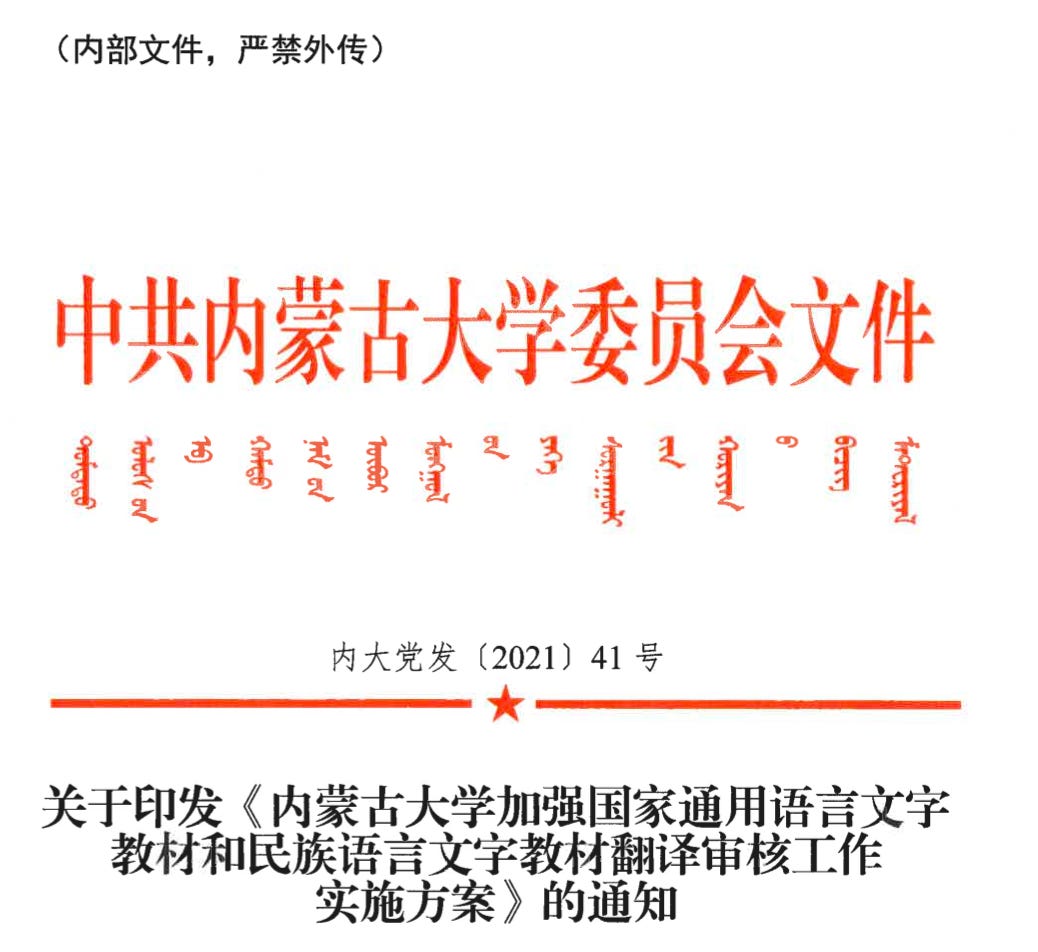
In my last article, I published Document No. 43, an internal directive issued by the Party Committee of Inner Mongolia University in December 2021. Now let’s look at Document No. 41, issued on the same day. It is the operational blueprint for textbook translation review, designed to implement the policy of “forging a strong sense of community for the Chinese nation.” Its stated purpose: to ensure that textbooks fulfill their role of zhuhun yuren (铸魂育人), “casting souls and cultivating people.” Note the character 铸, forge — the same one Teacher Wang taught us that day. Now it is being applied to souls(魂).
Authority
Document No. 41 is titled “Implementation Plan for Strengthening the Translation Review of National Common Language Textbooks and Ethnic Language Textbooks.”(内蒙古大学加强国家通用语言文字教材和民族语言文字教材翻译审核工作实施方案) It was approved at the same 72nd meeting of the university’s Party committee that produced Document No. 43, and carries the same stamp: “Internal Document — Strictly Prohibited from External Distribution.”(内部文件,严禁外传)
Document No. 41 did not originate at Inner Mongolia University. Its opening paragraph states that it was formulated "in accordance with" a directive from the National Textbook Committee Office: Opinions on Strengthening the Translation Review of National Common Language Textbooks and Ethnic Language Textbooks (《关于加强国家通用语言文字教材和民族语言文字教材翻译审核工作的意见》, 国教材办〔2021〕6号). The university's Party committee then adapted it to local conditions (结合学校实际).
The document declares that textbook development "embodies the will of the state and is a matter of state authority" (体现国家意志,是国家事权). The term guojia shiquan(国家事权) means that jurisdiction over this matter belongs to the central government alone.
The document also acknowledges that translation work has long had "weak links" (薄弱环节) — imprecise terminology, inaccurate expressions, content that "distorts the original meaning" (歪曲原意).
Scope
The document establishes one governing principle: fan fan bi shen (凡翻必审), "every translation must be reviewed." Section 2, titled "Scope of Review" (审核范围), spells out what this means. The scope covers all textbooks translated from the national common language (which is Chinese) into minority languages, and from minority languages into the national common language. It applies to textbooks at every level of education, as well as supplementary teaching materials (作为教材内容组成部分的教学材料) that form part of the curriculum.
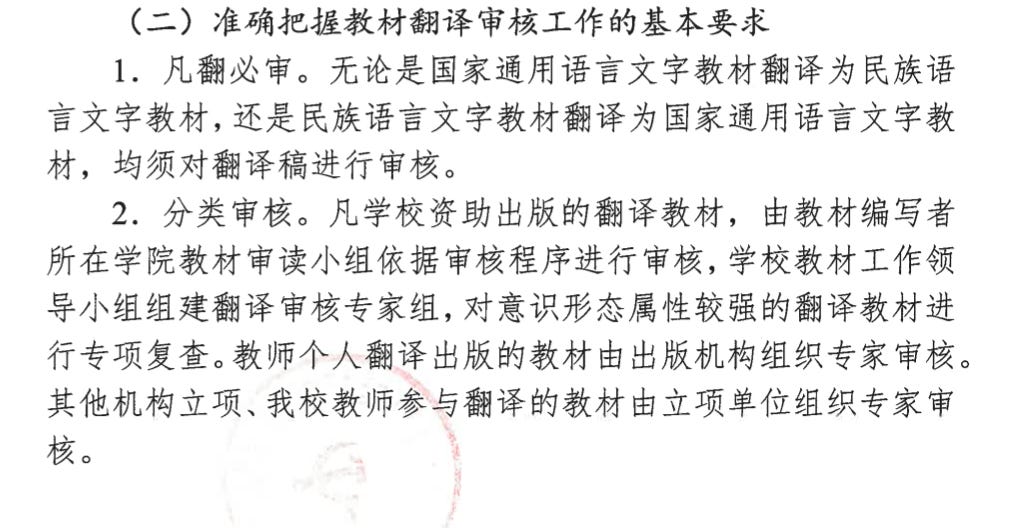
No publishing channel is exempt. The document divides review responsibility into three categories:
-
Textbooks funded by the university: the textbook author’s college-level review group (学院教材审读小组) conducts the initial review. The university’s Textbook Work Leadership Group then assembles a translation review expert panel (翻译审核专家组) to conduct a special review of textbooks with “strong ideological attributes” (意识形态属性较强的翻译教材).
-
Textbooks that individual faculty members translate and publish on their own: the publishing institution organizes expert review (由出版机构组织专家审核).
-
Textbooks commissioned by external organizations in which university faculty participate as translators: the commissioning organization organizes its own expert review (由立项单位组织专家审核).
Process
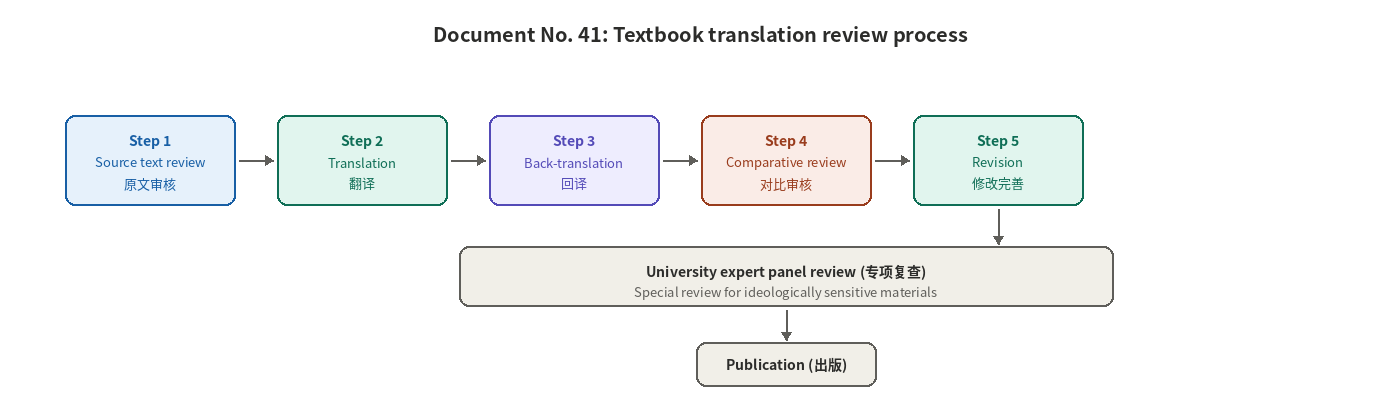
Section 3, titled “Review Procedures” (审核程序), lays out a five-step process for all school-funded translated textbooks.

Step 1: Source text review (原文审核). Before translation even begins, the original textbook is reviewed for content. The instruction is to “strictly guard the political gate, the scientific gate, and the appropriateness gate” (严把政治关、科学关、适宜关). Political vetting comes first.

Step 2: Translation (翻译). The textbook is translated in accordance with national language standards. The translation must be “faithful to the original meaning, precise in expression, fluent in language” (翻译要忠于原文原意,表达精准,语言通顺流畅)

Step 3: Back-translation (回译). This is the step that reveals the system’s true nature. The college organizes a separate group of experts to translate the translated textbook back into the source language. For disciplines with “strong ideological attributes” (意识形态属性较强) — the document names art and geography — important chapters must be back-translated in full (重要章节要部分回译). For other disciplines, key concepts and case studies with ideological content must be spot-checked (概念、案例要对照回译).

Step 4: Comparative review (对比审核). The back-translated text is placed side by side with the original source textbook to check translation accuracy (将回译教材与母版教材进行对比,检核翻译的准确性).

Step 5: Revision and finalization (修改完善). The translation is revised based on the comparative review, and the final manuscript is submitted to the university’s Textbook Work Leadership Group Office (报学校教材工作领导小组办公室).
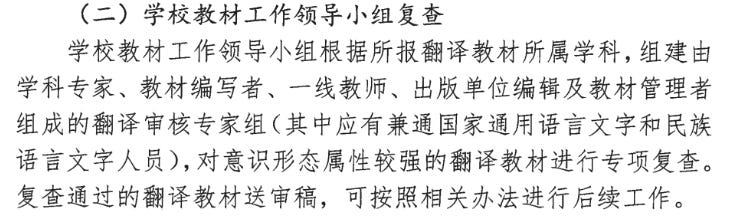
After these five steps, the textbook faces one more layer. The university’s Textbook Work Leadership Group assembles its own translation review expert panel (翻译审核专家组), composed of subject experts, textbook authors, frontline teachers, editors, and textbook managers. This panel must include members proficient in both the national common language and minority languages (应有兼通国家通用语言文字和民族语言文字人员). Textbooks with “strong ideological attributes” receive yet another special review (专项复查).
Framework
Document No. 41 is not a local initiative. On August 30, 2021, four months before Inner Mongolia University issued Document No. 41, the Ministry of Education issued the Administrative Measures for Primary and Secondary School Ethnic Minority Language Textbooks (《中小学少数民族文字教材管理办法》).
Article 16 specifies who reviews these textbooks. It lists the required composition of review teams, and then states: “During review, based on the specialized content areas involved in the textbook, materials shall be sent to the departments of propaganda, united front work, Party history research, public security, judiciary, state security, science and technology, education, culture and tourism, ethnic affairs, and religion for specialized review” (审核中根据教材涉及的专门领域内容送宣传、统战、党史研究、公安、司法、安全、科技、教育、文化和旅游、民族、宗教等部门进行专题审核).
Document No. 41 uses more restrained language at the university level — "expert panels" and "special reviews." But it operates within this national framework.
Output
What does a textbook look like after it has passed through this system?
Consider a page from a textbook currently used in Inner Mongolia’s schools. A boy introduces his family to the reader: “My father is Mongolian, my mother is Chinese” (我爸爸是蒙古族,妈妈是汉族)
At first glance, this looks like a celebration of diversity, a child from an interethnic family. But the boy is not being taught that his family carries two cultures.
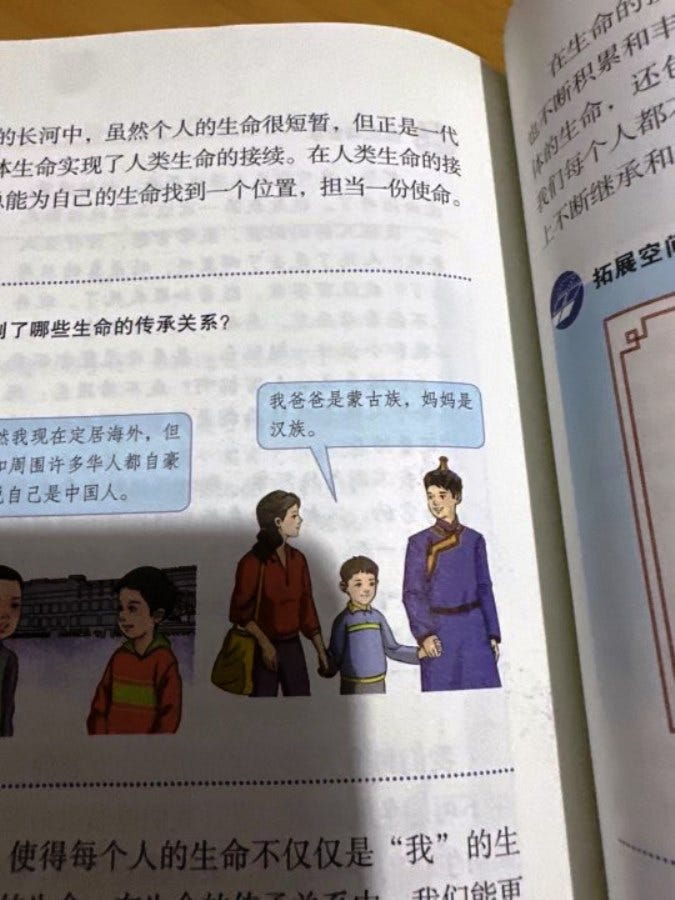
Teacher Wang taught us that 铸 means to smelt different elements and fuse them into a single, inseparable whole. Document No. 41 applies the same character to souls: 铸魂育人, casting souls and cultivating people. And here, at the end of the pipeline, is the product — a boy in a textbook, telling readers about his Mongolian father and Chinese mother, all of it dissolved into one identity, 中华民族.
Document No. 41 was not the last document issued that day.
Source:"Soul Casting": Leaked Document Reveals How China Controls What Minority Students Read