Six Years After the Mongolian Bilingual Education Reform: How One Policy Reshaped a Generation, Part I
Culture | Feature Report
That Autumn: How Mongolian Bilingual Education Reform Sparked Unprecedented Protests
By Borjigin Manda
Six Years After the Mongolian Bilingual Education Reform: How One Policy Reshaped a Generation, this three-part series looks at how the policy reshaped education, language use, cultural transmission, and educational choices in Southern Mongolia, and how its effects continue to shape a new generation.
Full Series:
- Part I — That Autumn: How the reform was introduced, the protests that followed, and how the movement came to an end.
- Part II — When Nothing would Change: How the reform transformed classrooms, textbooks, examinations, and educational choices.
- Part III — Beyond the Classroom: How the reform continues to shape language, public life, and the identity of a new generation.
Borjigin Manda is the founder and editor of Southern Mongolian News. As a Southern Mongolian, he writes about language rights, cultural preservation, and public policy affecting Southern Mongolia, with a focus on documenting cultural identity and promoting greater understanding of the experiences of Southern Mongolians.
That Autumn
Six years have passed since the Mongolian bilingual education reform was introduced in Southern Mongolia.
Public attention has long since moved on. The slogans that once echoed outside school gates have faded into silence. The students who stood at those gates in 2020 are now university graduates, young professionals, or young adults beginning lives shaped by decisions they never made.
Yet for many Southern Mongolians, the consequences of that autumn have never truly ended.
Today, many Southern Mongolians simply refer the events of 2020 as "that autumn." For those who lived through it, the phrase needs no explanation.
The reform changed far more than textbooks or classroom instruction. It altered how an entire generation encountered its mother tongue, understood its cultural identity, and imagined its future.
A Policy That Changed More Than Classrooms
In the fall of 2020, the Mongolian bilingual education reform took effect in Mongolian schools across Southern Mongolia.
Beginning that year, three core subjects—Chinese language, politics, and history—began using nationally standardized textbooks and taught in Mandarin Chinese. Although the reform was initially presented as applying only to these three subjects, its scope soon expanded.
By September 2023, Mandarin had become the sole language of instruction for all subjects in Mongolian schools.
As the policy expanded, it fundamentally changed the educational pathway that Mongolian students had followed for decades. The long-established Mongolian-language education system was gradually replaced by a Mandarin-medium system, bringing an end to the mother-tougue education that had been passed down for generations.
The transition also reshaped the teaching workforce. Thousands of Mongolian-language teachers across the region were reassigned, transferred to unrelated positions, or forced out of their teaching roles.
The significance of the reform extended far beyond education policy. It raised fundamental questions about the survival of the Mongolian language, the preservation of cultural heritage, and the future of Mongolian identity in Southern Mongolia.
Although the protests subsided within weeks, the consequences have continued to shape the lives of students, teachers, and families across the region.
Language is never merely a tool of communication. It carries history, memory, tradition, and a people's understanding of who they are. When its transmission through education is disrupted, young people are left to redefine their relationship with their heritage in a rapidly changing world.
Six years later, one question remains:
what has the reform actually meant for Southern Mongolian youth?
It Began with Rumors
For Temur (a pseudonym), then a final-year student at Inner Mongolia University, it all began with rumors.
In June 2020, reports spread online that Mongolian-language instruction would soon be replaced. Most people dismissed them as speculation. A change of that magnitude simply seemed impossible.
Then, in late August, official policy documents confirmed the rumors. Beginning that fall, three core subjects—Chinese Language, Politics, and History—would gradually adopt nationally standardized textbooks and Mandarin as the language of instruction.
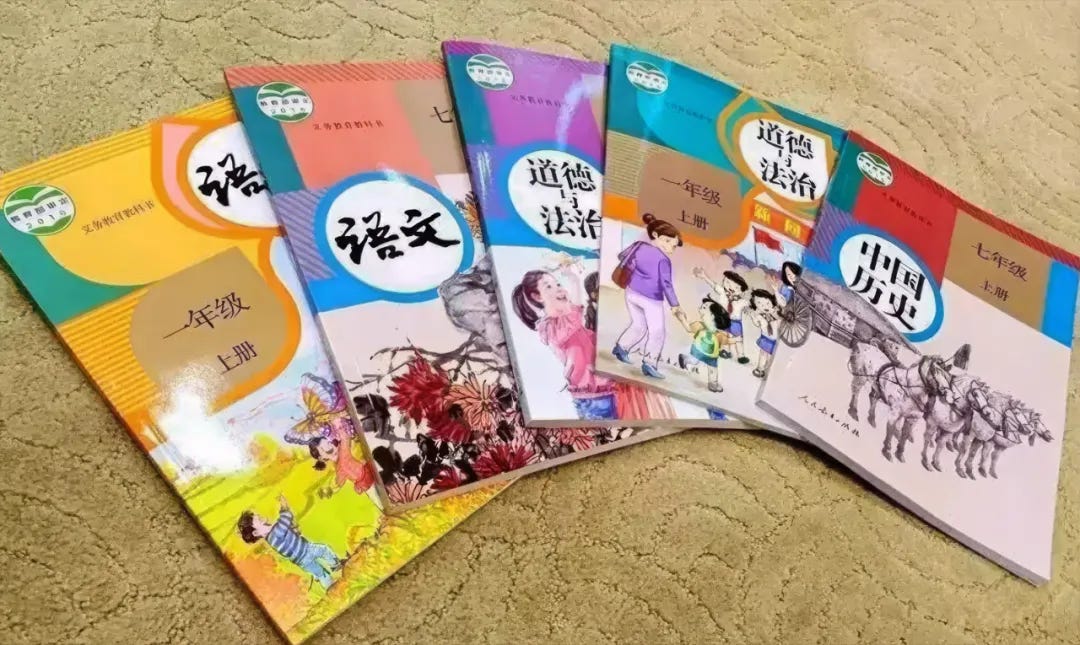
The nationally unified textbooks for Chinese language, politics, and history.
For decades, Southern Mongolia had maintained two parallel school systems: Mandarin-medium schools and Mongolian-medium schools. In the latter, Mongolian was the primary language of instruction and Mandarin was taught as an additional subject; students could progress from preschool all the way through graduate study within the Mongolian-language system.
For many Southern Mongolians, this bilingual system represented more than a method of instruction. It was a structure through which language, culture, and knowledge were passed from one generation to the next. Many regarded this bilingual model as essential to both educational development and cultural continuity.
Scholars at universities in Southern Mongolia issued joint statements warning that the existing system — in which Mandarin functioned as an additional language while Mongolian remained the principal means of preserving language and culture — was being upended. They argued that the new policy was not merely a change of textbooks or teaching methods, but a direct threat to the region's long tradition of minority-language education.
A Wave of Protests
A Movement Begins
The policy announcement triggered widespread opposition across Southern Mongolia.
On August 27, 2020, student representatives from East Ujimqin Banner submitted a statement of concern to the local education bureau.
The statement expressed concern that replacing Mongolian-language instruction in key subjects would weaken the role of Mongolian as a living language of education and cultural transmission:
"Every language represents a unique worldview, culture, philosophy, and way of thinking… If children receive more education in Mandarin than in their mother tongue during the critical period when they are developing language ability, the loss of their mother tongue will accelerate, and the consequences will be difficult to predict."
The education authority did not directly address these concerns. Instead, it insisted that the new nationally unified textbooks were "high quality" and "authoritative" materials that would deliver equal, high quality education to all.
For many students, teachers, and parents, however, the issue was never simply about textbooks.
At schools across Southern Mongolia, students and parents organized petitions calling for the preservation of the previous bilingual education system. Some petitions collected signatures alongside red handprints — a symbolic expression of support from local families and communities.
One petition circulated online showed dozens of signatures and handprints surrounding a message written in Mongolian:
"We sincerely request that the previous bilingual education system be maintained."
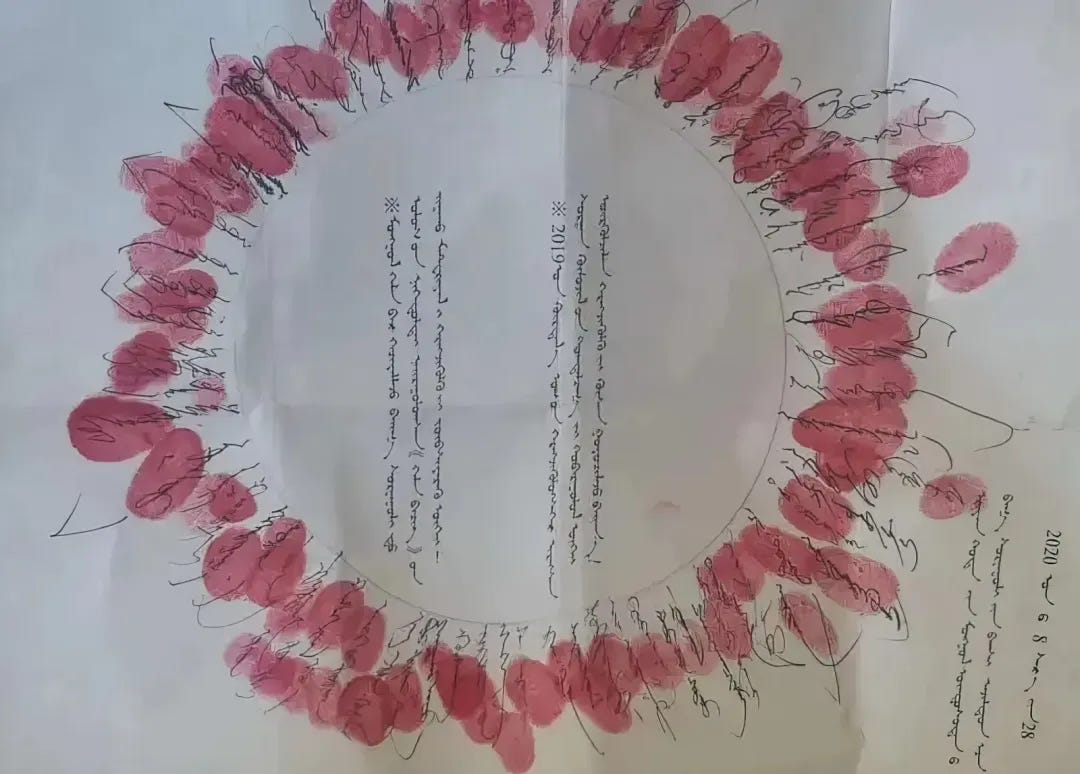
Petition with red handprints from Mongolian school teachers calling for the continuation of the previous bilingual education system.
At the university where Temur studied, students and teachers also joined efforts to express their opposition.
“We were shocked and angry,” Temur recalled. “It’s hard to explain where that anger came from.”
Across from Temur’s university stood a Mongolian high school. During the most intense days of the protests, Mongolian students gathered at the school gate, chanting slogans in defense of their language and education.
Mongolian students from the Affiliated High School of Inner Mongolia Normal University gather in a circle inside the school and chant slogans on September 1, 2020.
Just outside the entrance stood riot police and rows of police vehicles. The atmosphere was tense. Police also surrounded university dormitories, restricting students from gathering or moving in groups.
From inside the dormitory, listening to the voices outside, Temur found it impossible to remain calm. Videos circulating online showed similar scenes across the region: students pushing open school gates, parents being held back by police lines outside campuses, and groups of people standing quietly on empty roads, singing Mongolian folk songs together.
For many who participated, the protests were never simply about a change in textbooks. They reflected a deeper concern that the language carrying their history, memory, and identity was being gradually removed from the educational experience of the next generation.
A Region Responds
As concerns spread, opposition expanded beyond individual schools.
According to reports at the time, protests spread quickly across Southern Mongolia. Demonstrations and school boycotts took place in cities including Hohhot, Chifeng, and Tongliao.
The opposition also reached universities and public institutions. More than 2,000 students at Inner Mongolia University reportedly signed a collective petition opposing the implementation of the policy. More than 300 employees of Inner Mongolia Radio reportedly signed a joint statement expressing opposition to the changes to bilingual education.
The movement also affected local schools and government institutions. A number of Mongolian officials, teachers, and school principals resigned amid growing pressure over the reform. Some individuals also died by suicide during this period.
In early September 2020, at least one primary school principal and one government employee died by suicide. Their families told media that stress related to the language policy was a contributing factor.
For many Southern Mongolians, these events reflected the depth of concern surrounding the reform. What had begun as opposition among students and parents had expanded into a broader social movement involving educators, public employees, and communities across the region.
Beyond Borders
The protests did not remain confined within Southern Mongolia.
As news of the reform spread, Southern Mongolian communities around the world organized demonstrations and advocacy campaigns in opposition to the ban on Mongolian-language education.
-
Mongolia
On August 31, 2020, protesters gathered outside the Chinese Embassy in Ulaanbaatar, Mongolia, to oppose the changes to Mongolian-language education in Southern Mongolia.
The demonstration drew attention because of the close historical and cultural ties between Mongolia and Southern Mongolia. Protesters expressed concern that reducing the role of Mongolian in schools could weaken the language’s future as a medium of education and cultural transmission.
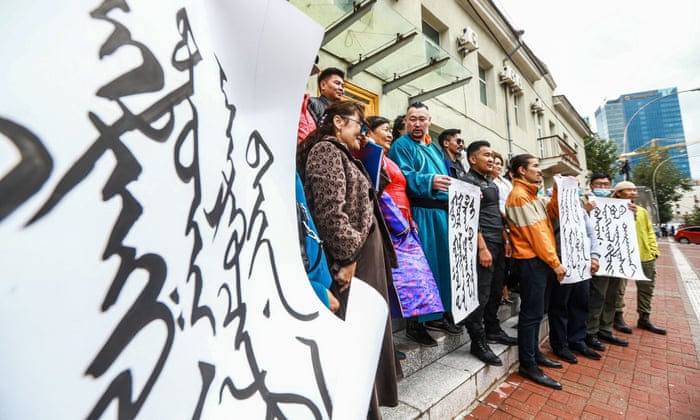 Protesters gather in Ulaanbaatar, the capital of Mongolia, against China’s plan to introduce Mandarin-only classes in Southern Mongolia. Photograph: Byambasuren Byamba-Ochir/AFP/Getty Images
On September 15, during Chinese Foreign Minister Wang Yi’s visit to Mongolia, more than one hundred protesters gathered in Ulaanbaatar to voice opposition to Beijing’s language policy in Southern Mongolia.
-
United States
In the United States, Mongolian communities and supporters organized demonstrations and advocacy activities calling attention to the changes in Mongolian-language education in Southern Mongolia.
The protests took place amid growing international concern over the policy. In Washington, D.C., members of the Southern Mongolian diaspora and supporters gathered outside the Chinese Embassy, calling for protection of Mongolian language and cultural rights.
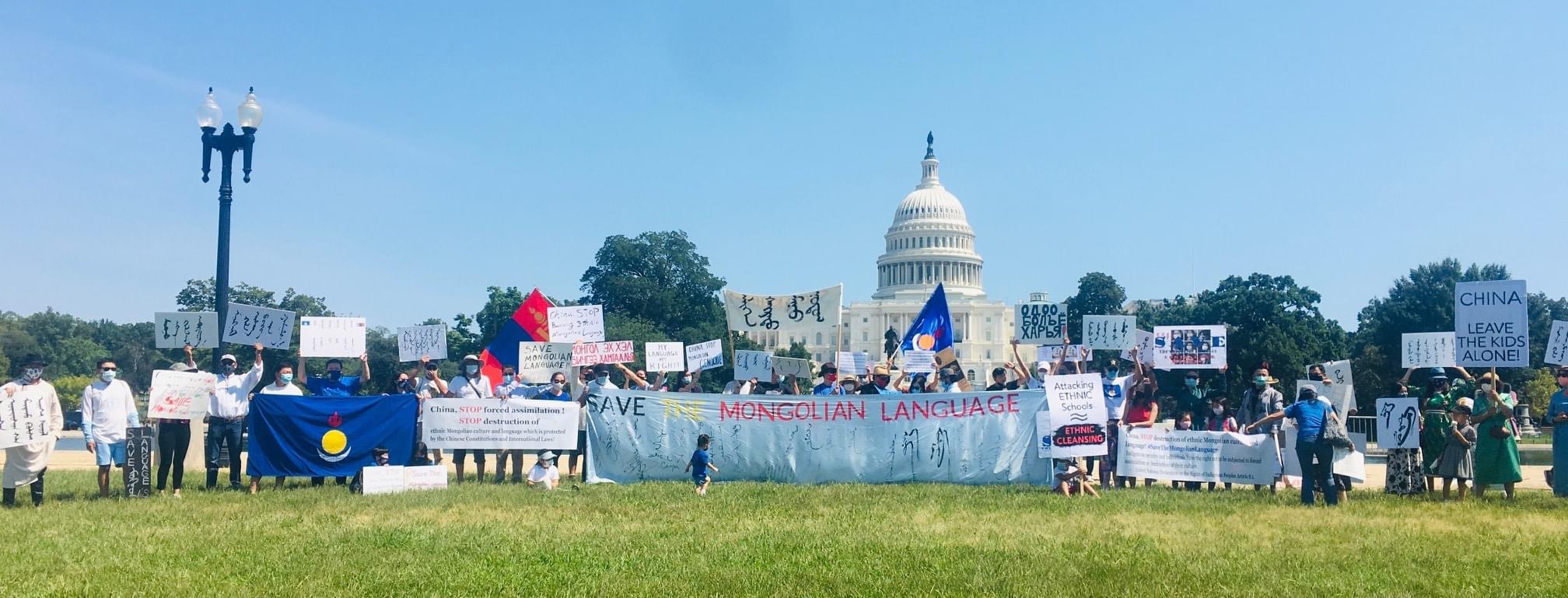
Southern Mongolian supporters gather in Washington, D.C., on September 7, 2020, to protest China’s changes to Mongolian-language education policies in Southern Mongolia.
The issue also drew attention from U.S. human rights organizations and lawmakers. The Congressional-Executive Commission on China (CECC) later condemned the suppression of protests in Southern Mongolia and called for the release of individuals detained for participating in peaceful demonstrations.
-
Japan
Beyond Mongolia and the United States, Mongolian communities in Japan also organized protests, calling on the Chinese Communist Party not to end Mongolian-medium education in Southern Mongolia.
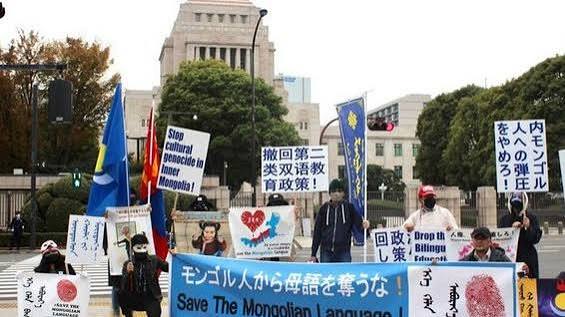
Southern Mongolian students in Japan protest during Chinese Foreign Minister Wang Yi‘’s visit.The protesters held up banners and placards in Mongolian, Chinese, Japanese, and English, such as "Withdraw the sinicization policy!", "Stop cultural genocide in Inner Mongolia!", and "Give Mongolians back their mother tongue!"
For many overseas protesters, the reform was not simply an education policy change; they saw it as a question of language rights and cultural survival. They warned that reducing the role of Mongolian in schools could accelerate linguistic assimilation by separating younger generations from the language through which their history, literature, and collective memory had been transmitted.
To many protesters, this was not only about what language students used in classrooms. It was about whether future generations would still be able to learn, think, and participate in public life through Mongolian.
When the Voices Fell Silent
Despite the scale of opposition, the movement began to lose momentum within weeks.
The end of the movement did not mean that concerns had disappeared. Instead, increasing pressure, fear of punishment, and uncertainty about the consequences gradually made continued participation more difficult for many students, parents, and community members.
On September 2, 2020, the Horqin District branch of the Tongliao Public Security Bureau published a wanted list through its official WeChat account. The list eventually included 129 names under the charge of “picking quarrels and provoking trouble.”
The photographs published with the list were not standard identification photos, but appeared to be screenshots taken from protest videos. Those named were widely believed to be individuals who had participated in opposing the reform.
The publication of the list sent a warning throughout local communities. For many participants, the possibility of being identified, investigated, or punished added another layer of fear to an already tense situation.
On September 15, 2020, the National Standard Textbook Implementation Command Office in Xilinhot issued a public notice warning parents who had not sent their children back to school.
The notice stated that families who complied with the policy before the deadline would continue to receive certain government support, while those who refused to send their children back to school could face the suspension or cancellation of various benefits.
Among its provisions, the notice stated:
“Parents who fail to send their children to school by the specified time will have all municipal agricultural and pastoral subsidy policies cancelled. Financial institutions, including the Agricultural Bank of China and rural credit cooperatives, will suspend loan services for five years.”
The notice also stated that high school students who failed to return to school would be treated as having withdrawn voluntarily and have their enrollment status cancelled, while primary and middle school students could lose various forms of financial assistance.
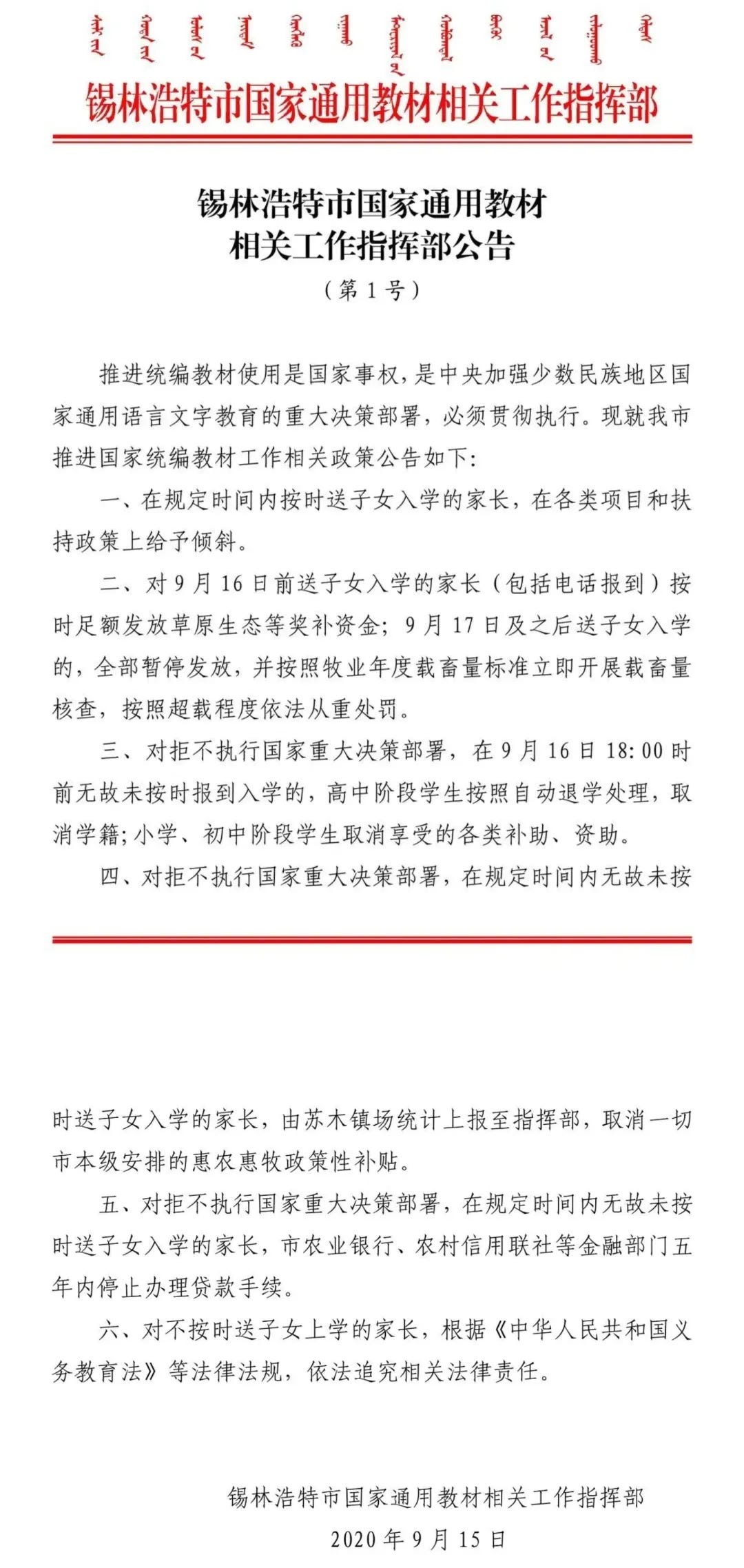
Announcement from the National Standard Textbook Implementation Command Office in Xilinhot (Source: Xilinhot Education WeChat account)
For many families, especially those in rural and pastoral communities, the consequences reached into everyday family life. The decision became connected to household income, government support, and access to financial resources.
“Without loans from rural credit cooperatives, it is very difficult for herders to make a living,” Temur explained.
Many herding families had already been facing economic pressure due to grazing restrictions and seasonal grazing bans expanded across the region since the early 2000s. These policies had reduced families’ traditional income sources, leaving many dependent on loans and government support programs.
For them, such warnings created a difficult choice. Opposing the reform was not only a matter of personal belief or cultural identity; it could also affect a family’s livelihood and a child’s education.
The pressure did not come only from official notices. According to Temur, the government's portrayal of overseas protests also affected public opinion inside Southern Mongolia.
Some demonstrations abroad included slogans related to “self-determination” and “an independent Mongolia” — language that Chinese authorities viewed as politically sensitive.
“People inside the country began to believe the protests were all organized by ‘foreign forces,’ and that we couldn’t be associated with them,” Temur said. “That was one reason the momentum faded.”
As pressure increased, schools gradually returned to normal operation. The gatherings outside school gates became quieter. The voices that had echoed across Southern Mongolia only weeks earlier began to disappear.
But silence did not mean resolution.
For the students who had stood outside school gates, for the parents who had signed petitions, and for the teachers who had spoken out, the reform had already changed something fundamental: the relationship between language, education, and identity.
The protests ended.
The reform continued.
Continued in Part II
When Nothing Would Change: How the reform transformed classrooms, textbooks, examinations, and educational choices, and how, despite official assurances that "nothing would change," Mongolian-language education entered a new reality.
Names marked as pseudonyms in this series, are used to protect the identities of sources.