Six Years After the Mongolian Bilingual Education Reform: How One Policy Reshaped a Generation, Part II
Culture | Feature Report
When Nothing Would Change: Inside the Transformation of Mongolian Education
By Borjigin Manda
Six Years After the Mongolian Bilingual Education Reform: How One Policy Reshaped a Generation, this three-part series looks at how the policy reshaped education, language use, cultural transmission, and educational choices in Southern Mongolia, and how its effects continue to shape a new generation.
Full Series:
- Part I — That Autumn: How the reform was introduced, the protests that followed, and how the movement came to an end.
- Part II — When Nothing would Change: How the reform transformed classrooms, textbooks, examinations, and educational choices.
- Part III — Beyond the Classroom: How the reform continues to shape language, public life, and the identity of a new generation.
Borjigin Manda is the founder and editor of Southern Mongolian News. As a Southern Mongolian, he writes about language rights, cultural preservation, and public policy affecting Southern Mongolia, with a focus on documenting cultural identity and promoting greater understanding of the experiences of Southern Mongolians.
The protests ended.
The reform continued.
Part I of this series traced the origins of the 2020 policy and the protests it set off across Southern Mongolia. This installment follows what came after: how the reform actually unfolded — in classrooms, on exam papers, and in public life — over the six years since, despite official assurances that "nothing would change."
Saying Nothing Would Change — While Everything Was Changing
To calm public anger, the government issued a response in late August 2020, promising what it called the "Five No Changes"(五个不变). After the nationally compiled textbooks for three subjects — Chinese language, politics, and history — were introduced, officials pledged that everything else would remain as it was: no other change to the curriculum in ethnic primary and junior high schools, no change to existing textbooks, no change to the language and script of instruction, no change to the class hours allotted to Mongolian and Korean language courses, and no change to the existing model of bilingual education itself.
In September 2020, the Inner Mongolia Education Department also launched an online Q&A platform to address public concerns about the new nationally compiled textbooks.
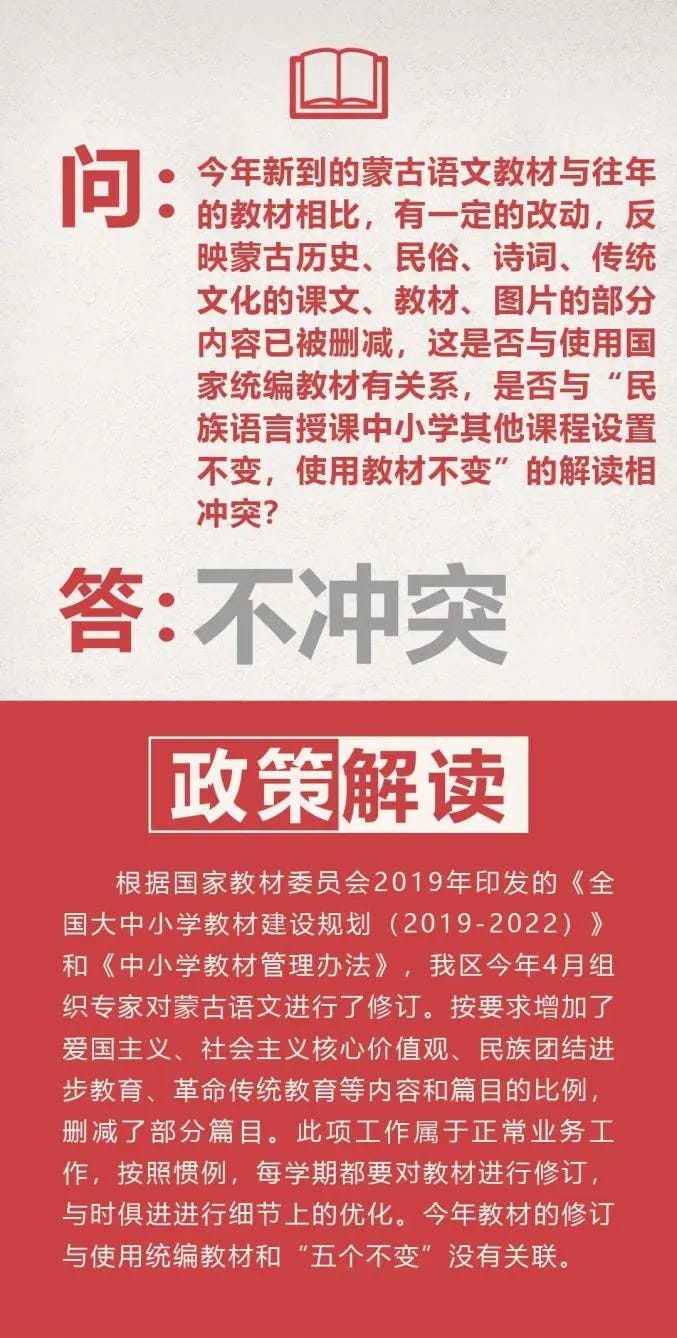
An official Q&A posted by the Inner Mongolia Education Department in response to public concerns about changes to Mongolian-language textbooks.
"The newly revised Mongolian-language textbooks have removed passages on Mongolian history, folk customs, poetry, and traditional culture. Doesn't this conflict with the government's promise that existing textbooks would remain unchanged?"
The official response began with a simple answer:
"No conflict."
It explained that the textbooks had been revised to increase content on "patriotism, socialist core values, ethnic unity and progress education, and revolutionary tradition education," while other material had been removed, insisting that these revisions were unrelated to the introduction of the nationally standardized textbooks.
What followed told a different story.
Altan (a pseudonym), then a fourth grader, was one of many students who returned to school only after the initial uproar had begun to subside. The most immediate change he noticed was the textbooks: his Mongolian-language classes had been replaced by the far more demanding nationally standardized Chinese-language editions.
"At the beginning, we simply couldn't keep up," he recalled. "We couldn't understand the classical Chinese texts, and we almost never passed the dictation tests." He added, not without a note of pride, that his generation's Chinese eventually outpaced their teachers' — "because learning a language as a teenager is completely different from learning a new one after thirty or forty." By fifth grade, he had adjusted to the new curriculum.
Looking back on those years, Altan remembers that every Monday, he and his classmates once wore their finest traditional Mongolian dress, with red scarves, to the flag-raising ceremony. After the reform, students were permitted only standardized school uniforms. The ethnic Mongolian primary school he attended — once home to roughly 300 students — has since been converted into a Han Chinese school as enrollment declined.
By the time Altan entered middle school in 2022, the changes had deepened. Apart from Mongolian-language class itself, every other subject now used two sets of textbooks: the official nationally compiled Chinese editions and Mongolian translations published by the Inner Mongolia Publishing House. Because local policy remained unclear, teachers didn't know which language future exams would ultimately require, and defaulted to teaching from the national Chinese textbooks — often in what students wryly called "grassland-accented Mandarin." By his second year, nearly all instruction had shifted to Chinese, with the exception of one biology teacher not yet comfortable speaking it.
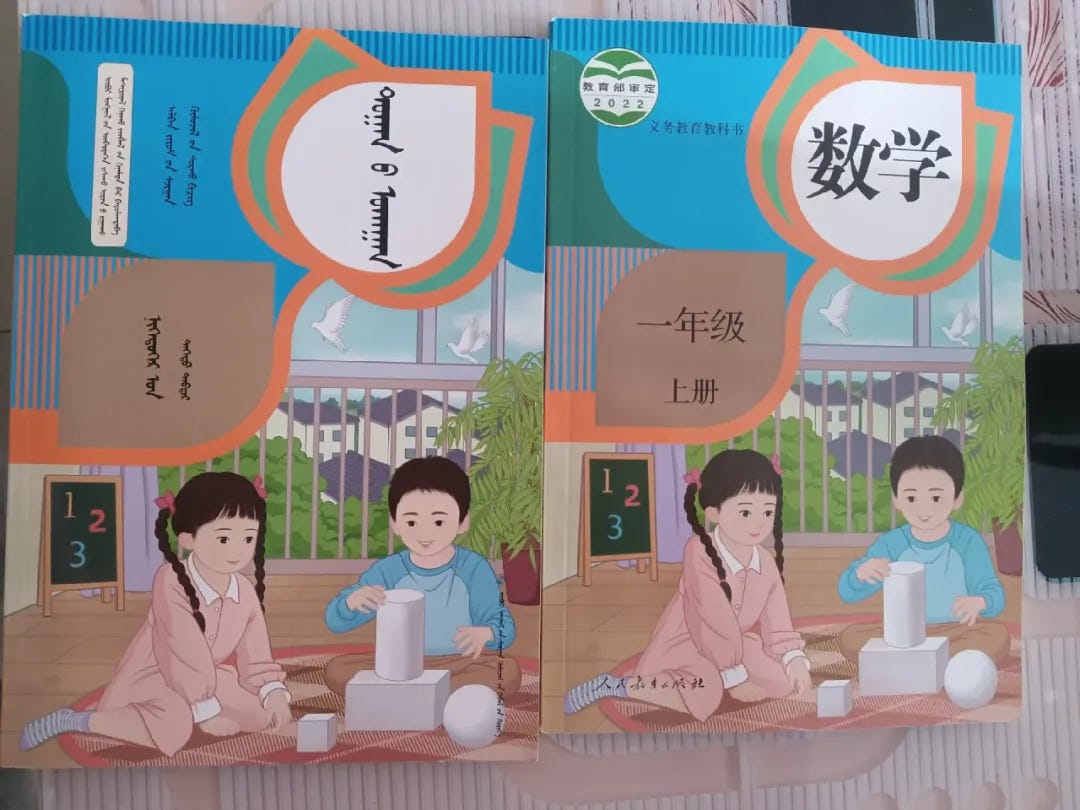
A first-grade mathematics textbook approved by China's Ministry of Education in 2022 (right), alongside its Mongolian-language translated version (left).
Even the smallest background details in textbook illustrations were not exempt from this substitution. In one widely circulated comparison, the same illustration — a scene of children arriving at school — appears in two different textbook editions. In the earlier version, the gate sign behind the children reads "Mongolian Primary School" (蒙古族小学) in Mongolian script. In the later edition, the same sign has been redrawn with the identical name rendered in Chinese characters instead, and a new Chinese-language banner reading "Welcome, new students" (欢迎新同学) has been added beside the gate. The school's name and identity in the illustration remain unchanged; only the script in which that identity is expressed has been replaced. Because the sign was never central to the lesson itself — a piece of incidental scenery rather than instructional content — its quiet substitution illustrates how thoroughly the shift away from Mongolian script has been absorbed into routine editorial practice, extending even to details unlikely to draw a reader's notice.
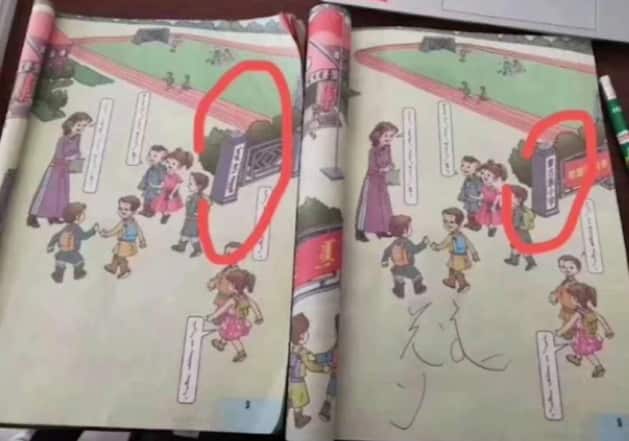 A textbook illustration of children arriving at school, compared across two editions: in the earlier version (left), the school gate sign reads "Mongolian Primary School" in Mongolian script; in the later version (right), the same sign has been redrawn in Chinese characters, with a Chinese-language welcome banner added beside it.
After middle school, Altan's strong academic record earned him a place at a Han Chinese high school rather than a Mongolian-language one. That school had once offered first-year Mongolian classes for its Mongolian students — one to three lessons a week, a number that was already shrinking year over year. "The school kept these classes going despite the pressure," Altan said, though they were never assigned a fixed classroom and were often taught in labs or spare rooms. By the time he enrolled, even that residual instruction had disappeared entirely.
In November 2025, after hearing that his former middle school had begun admitting Han Chinese students, Altan returned to visit his old Mongolian-language teacher. She spoke with sadness about her situation: the middle-school division no longer offered Mongolian classes at all, and she had been reassigned — mostly to teach labor education, with only occasional, non-examinable Mongolian lessons for first-year high schoolers.
"Toward the start of the reform, many parents were unhappy with the policy. They still insisted on sending their children to Mongolian-medium schools because they wanted their children educated in their mother tongue," said one Mongolian-school teacher, speaking on condition of anonymity. "But the policy has now been in place five or six years. Parents have gradually accepted the reality — they've become more pragmatic, and less inclined to enroll their children in Mongolian schools. If Mongolian schools and Han schools teach the same subjects from the same textbooks, why not send children to Han schools, where they may find better opportunities?"
The area hit hardest by the reform has been the college entrance examination (gaokao) system.
Nomin (a pseudonym), a Mongolian student, often feels fortunate to have been born a year earlier than she might have been: 2024, the year she sat the exam, was the last cohort admitted under the traditional Mongolian-language examination system in Southern Mongolia. Like Mongolian students for the preceding four decades, she had received a Mongolian-medium education from childhood, studying and living mostly in Mongolian apart from fewer than five weekly Chinese-language classes. Under the old system, Mongolian carried real weight: every subject's exam paper was translated into Mongolian, while the Chinese-language component — often called the "ethnic Chinese exam" (民族汉考) — was comparatively simple and counted for less of the total score.
Starting with the 2025 cohort, Mongolian-medium students must sit the same exam as their Han Chinese peers: the nationally standardized Chinese-language paper, worth 150 points with a 90-point pass threshold, plus Chinese-language questions across subjects including Chinese language, politics, and history. Mongolian is no longer a required exam subject at all — it has become an optional supplementary test relevant only to admission into certain programs.
For Mongolian students without a strong grounding in Chinese-language academic study, this shift has raised the stakes of higher education considerably. In the standardized exam system, Mongolian's status has fallen sharply as Chinese-language proficiency has become paramount.
Beyond the Classroom: The Shrinking Space of the Mother Tongue
The reach of these policies has extended well past the classroom. Across broader society, Mongolian has been increasingly marginalized — in some places pushed out of public space altogether. More public signage has shifted to Chinese-first formats or dropped Mongolian entirely. Speaking Mongolian has gradually moved from being a normal part of public life to something confined largely to the home — a "kitchen language," in the words used by several people interviewed for this series, rather than a language of society at large.
The 2005 Regulations on Mongolian Language and Script Work of Inner Mongolia Autonomous Region (内蒙古自治区蒙古语言文字工作条例) had tied the Mongolian language closely to the region's autonomy, describing it as "a common language and script of the autonomous region and an important tool for exercising autonomy," and obligating governments at every level to protect citizens' rights to learn, use, research, and develop it.
That regulation was replaced in 2022 by the Implementation Measures of the National Common Language and Script Law in Inner Mongolia Autonomous Region (内蒙古自治区实施《国家通用语言文字法》办法), which places far greater emphasis on Mandarin as the basic language of instruction and describes the learning and use of minority languages only as something to be "respected and protected." In practice, the change weakened Mongolian's prior official status and public standing across the region.
Traces of three distinct linguistic eras are still visible in Southern Mongolia's public spaces. The first dates to the Cultural Revolution, when Chinese dominated and Mongolian was treated as secondary. The second lasted until 2022: Mongolian and Chinese appeared together on signage, with Mongolian often given priority — placed above Chinese, or to the left, on bilingual signs from shopfronts to public facilities. After 2022, many newly made signs reversed that order or dropped Mongolian altogether, and some existing Mongolian-language signage was physically removed or altered, leaving visible marks of erasure.
One example: the trilingual stone marker at the ruins of Shangdu (上都), former capital of the Yuan Dynasty. Before 2022, the languages ran top to bottom as Mongolian, Chinese, and English. Afterward, Chinese was moved to the top — and the uneven white scars left by removing the original text remain visible on the stone.
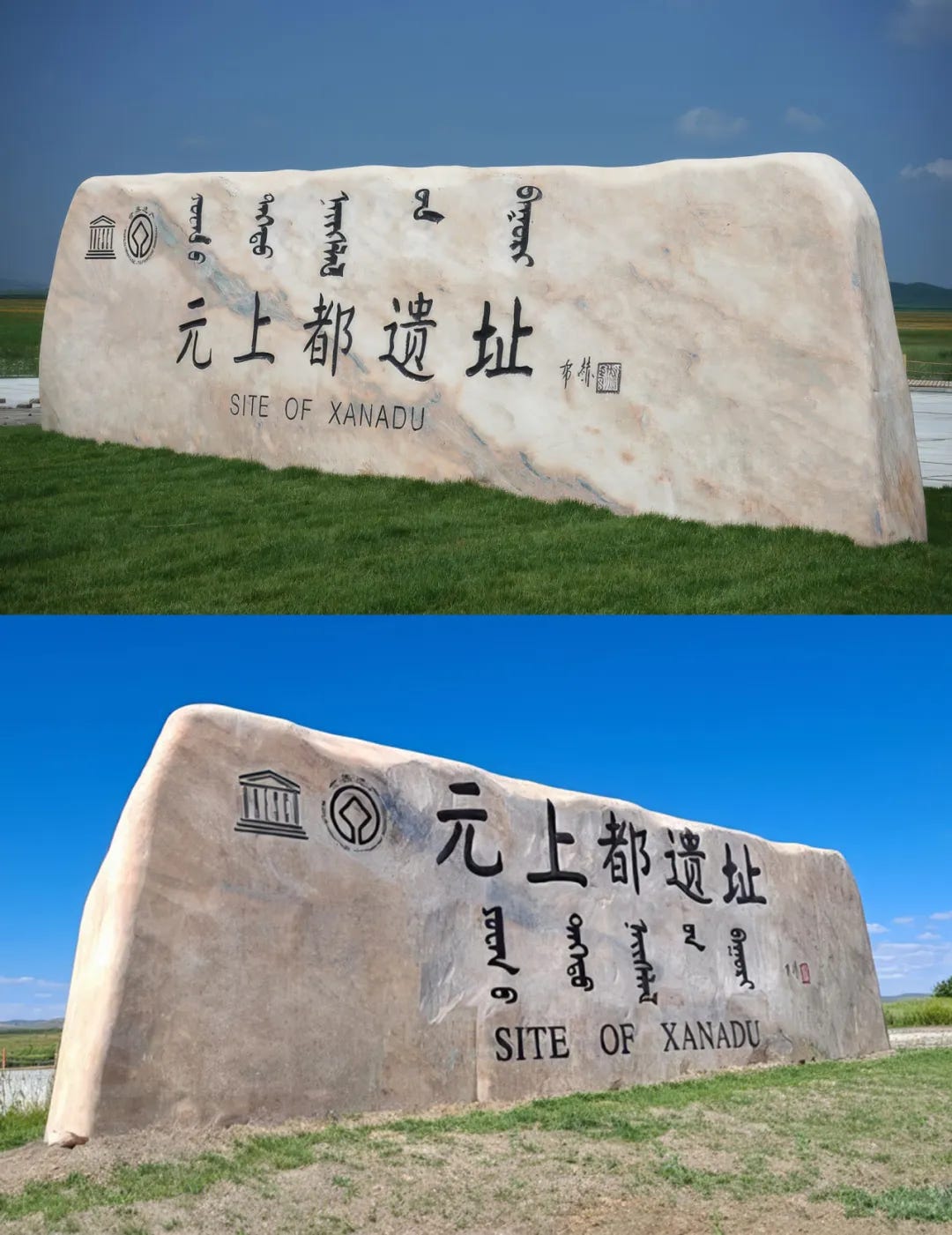
The trilingual sign at the ruins of Shangdu, photographed in October 2021 (top) and July 2022 (bottom). The white marks left after the original text was removed remain visible.
The most recent wave of change has come through the renaming of ethnic schools. In late October 2025, several Mongolian schools in cities including Tongliao and Chifeng were renamed — "Tongliao Mongolian Middle School" became "Tongliao No. 2 Middle School," and "Chifeng Mongolian Middle School" became "Chifeng No. 1 Middle School" — stripping ethnic references from institutions that had long stood for Mongolian-language education. Online videos showed some schools removing Mongolian-language signage from their buildings altogether. Local residents described sadness and disappointment, returning to photograph their old school entrances as a way of holding onto what was being lost.
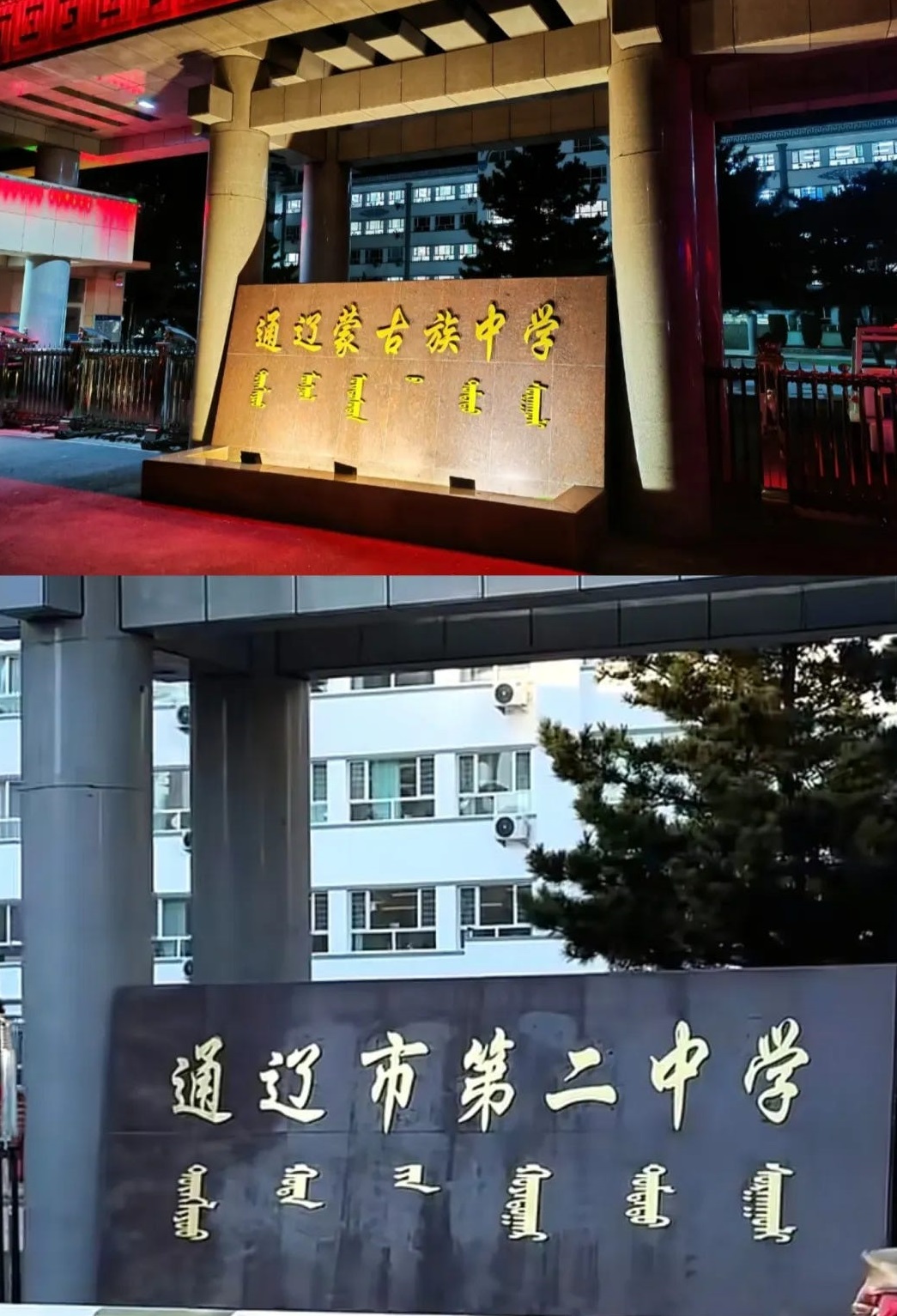
In October 2025, Tongliao Mongolian Middle School was renamed Tongliao No. 2 Middle School.
Across Southern Mongolia — from east to west, city to countryside — the number of people who speak Mongolian day to day keeps falling.
Buyan (a pseudonym), a Japan-based designer who has devoted himself to documenting and promoting Mongolian language and culture, remembers a childhood when traditional Mongolian dress was common on city streets, ethnic identity was visible at a glance, and speaking Mongolian in daily life felt entirely natural. Today, when he returns home to document traditional culture and searches different cities for Mongolian-speaking communities, he finds very few people who still speak the language.
Writing in the earliest days of the policy — before the school year that triggered it had even begun — Christopher Atwood, a professor in the Department of East Asian Languages and Civilizations at the University of Pennsylvania, warned that the change would cripple Mongolian children's ability to express themselves in their own language:
"The change will cripple the ability of those Mongol children in Mongolian-medium schools to express themselves in their mother tongue on a full range of subjects. Literacy is not an on/off thing, but occurs in a range of social functions, which must be practiced to be successfully mastered. The removal of politics, morals and morality, and history from the range of subjects that Mongolian children will be trained to read, write, listen, and speak about in their mother tongue will further weaken the language, pushing it closer towards a 'kitchen language' that can only be used for in-family conversations and lacks vocabulary and rhetorical sophistication for public written and oral use." (Christopher P. Atwood, "Bilingual Education in Inner Mongolia: An Explainer," Made in China Journal, 30 August 2020.)
Six years on, that prediction reads less like a warning than a description of what actually happened.
More troubling still, even that kitchen-language space is beginning to erode. In the summer of 2025, while visiting eastern Southern Mongolia, Buyan watched a grandmother having a meal with her granddaughter at a noodle restaurant. The woman spoke fluent Mongolian on a phone call — then switched effortlessly to Chinese the moment she turned to her granddaughter: "Eat quickly, don't spill it."
It was a small moment. But it points to a much larger question: when a language disappears from schools, public space, and everyday conversation, how long can it survive inside families alone?
Beyond the Classroom: How the reform has reshaped public life, language use, and the identity of a new generation of Southern Mongolians — and what it means to preserve a language that is gradually disappearing from everyday life.
Names marked as pseudonyms in this series, are used to protect the identities of sources.