China's New Exit Rules Expand Control Over Southern Mongolians: A Cross-Border System Emerges
By Borjigin Manda
Southern Mongolian News
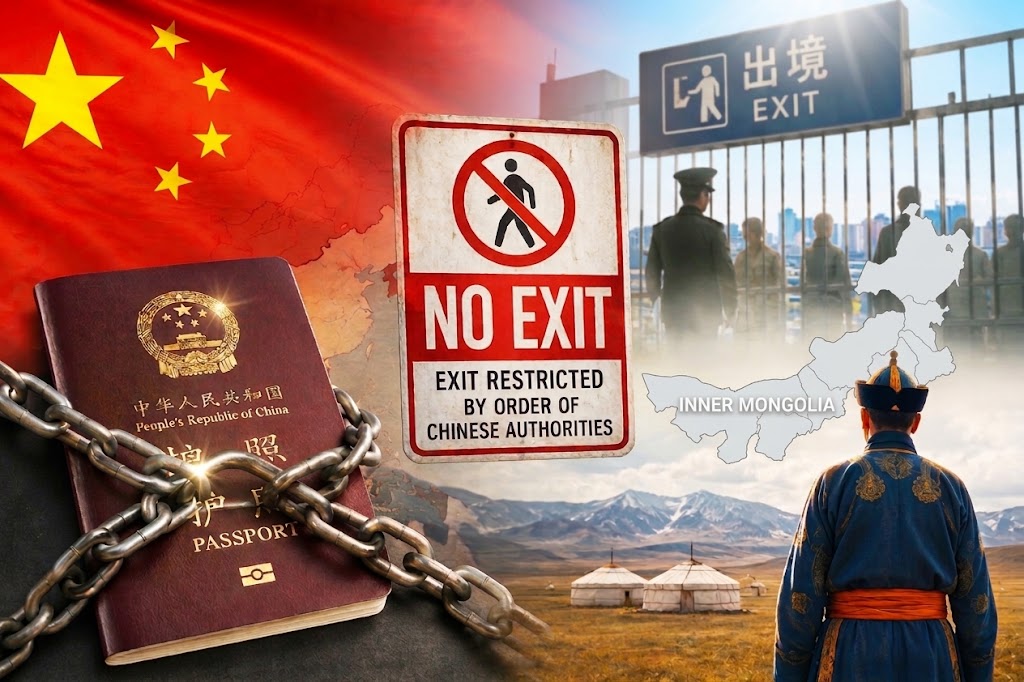
Illustration: China’s expanding exit controls and their implications for Southern Mongolians.
China's government has recently introduced a series of new regulatory measures that are constructing an increasingly intricate cross-border control system with far-reaching implications for Southern Mongolian communities both inside and outside the country. These measures combine exit restrictions with oversight of overseas activities, creating a control network that extends well beyond conventional travel limitations.
New Regulations Broaden Legal Grounds for Exit Restrictions
On July 31, China's State Council issued new Provisions on Exit and Entry Administration, which take effect on September 15. Under Article 4, Chinese citizens who engage overseas in illegal or criminal activities deemed to endanger national security or national interests may be barred from leaving China for six months to three years after returning. Additionally, the provisions allow exit restrictions for certain violations of export-control and technology-related regulations that threaten national industrial or technological security, without specifying a maximum period.
This means that starting September 15, individuals' activities abroad could directly affect their freedom of movement upon return to China.
New Layer Added to Existing Control Mechanisms
The issuance of these new rules is not an isolated development. In Southern Mongolia, exit and passport controls have been documented practice for years.
In July 2020, Hohhot Minzu University issued a notice requiring all faculty and staff to surrender their passports and Hong Kong, Macao, and Taiwan travel documents for centralized custody by the university's Human Resources Office. Employees who failed to comply faced disciplinary action under relevant regulations. Similar passport custody systems have been implemented across multiple regions of China, affecting teachers, doctors, nurses, and state-owned enterprise workers.
What does passport confiscation mean in practice? Simply possessing a passport does not necessarily guarantee the freedom to use it. Some public employees have been explicitly told that traveling abroad without permission could result in disciplinary action or even dismissal.
"Long-Arm Jurisdiction" Extended to Overseas Activities
On July 1, the Law on Promoting Ethnic Unity and Progress took effect. Article 63 specifically addresses organizations and individuals outside China, providing for legal consequences for conduct deemed to undermine ethnic unity and progress or promote ethnic separatism.
Chinese officials have explicitly acknowledged that this provision applies to conduct occurring outside China's borders. In June, Vice Minister of Justice Hu Weilie stated that overseas organizations and individuals engaging in ethnic separatism or undermining China's ethnic solidarity could be held legally accountable. Chinese authorities rejected characterizations of the provision as "long-arm jurisdiction" or extraterritoriality.
For overseas Southern Mongolian communities, this legislative development marks a significant turning point: China's regulatory framework concerning ethnic identity and political expression now has explicit legal reach beyond its borders. For years, overseas Southern Mongolian communities have documented and reported on restrictions affecting Mongolian-language education, cultural policies, and the erosion of Mongolian identity. Many have organized cultural programs, conducted research, or engaged in international advocacy on these issues. These activities now operate within a more restrictive legal environment.
Cross-Border Pressure: A System Without Escape
For Southern Mongolians living abroad, the implications extend far beyond questions of travel freedom.
Many overseas Southern Mongolians maintain close family ties—parents, siblings, and other relatives remain in Southern Mongolia. These family connections have become a point of vulnerability. In documented cases, pressure applied to relatives inside China has been used to influence those living abroad.
According to a U.S. congressional bill on Southern Mongolian human rights, at least five Southern Mongolian dissidents living in exile have been forcibly returned to China since 2009. The bill specifically cites the case of Lhamjab Borjigin, a Southern Mongolian writer and historian who was detained by Chinese police in Ulaanbaatar on May 3, 2023, and transported to China the same day.
Broader research and reporting on China's transnational repression document surveillance, intimidation, and pressure targeting relatives of people living abroad. Similar patterns have been documented among Tibetan and Uyghur communities, where family members remaining inside China have been threatened or pressured because of the overseas activities of relatives.
The Emergence of a Multi-Layered Control System
The significance of these changes lies in how they work together:
Inside Southern Mongolia, teachers, healthcare professionals, state employees, and some enterprise workers have already surrendered their passports to employers, with overseas travel contingent on institutional approval.
At China's borders, the new exit provisions provide authorities with additional legal grounds to prevent people from leaving China. Simultaneously, existing cross-border pressure mechanisms—including forced repatriation and pressure on family members—persist and may intensify.
Globally, the new Law on Promoting Ethnic Unity and Progress provides a new legal mechanism for scrutinizing and constraining the activities of overseas Southern Mongolian communities.
Working in concert, these measures create a broader control system connecting Southern Mongolians inside China, their family members, and Southern Mongolian abroad. Passport and exit controls are no longer solely about whether someone can leave China—they have become components of a larger system that transcends national borders.
Implementation and Implications
The new exit provisions take effect on September 15. The breadth of their actual implementation remains to be seen, but for Southern Mongolians, these new measures represent a further tightening of restrictions that have already been in place for years—involving exit limitations, passport controls, and cross-border pressure.
For Southern Mongolian communities scattered across the globe, this government-driven control network is extending its reach ever further. Whether individuals reside inside or outside China, they may find themselves affected by mechanisms designed to constrain movement, regulate expression, and monitor activities across international borders.
Interconnected Pressures: What It Means
The system that has emerged operates on multiple levels:
- Personal mobility is restricted through passport custody and exit bans
- Family relationships become points of leverage through pressure on relatives
- Overseas activities fall under new legal scrutiny through ethnic-unity legislation
- Return to China becomes contingent on past overseas conduct
For Southern Mongolians, the cumulative effect is a system in which geographic distance no longer provides protection from Chinese state control, and in which family ties and overseas activities create vulnerabilities that reach across borders.
Key Sources
- China's State Council — Provisions on Exit and Entry Administration (July 31, 2026)
- China's State Council — Law on Promoting Ethnic Unity and Progress (July 1, 2026)
- U.S. Congress — Southern Mongolian Human Rights Policy Act
- Hohhot Minzu University — Notice on the Centralized Custody of Passports and Other Travel Documents (July 2020)
- Freedom House — China: Transnational Repression
- The New York Times — "No Passports, No Study Abroad: China Limits Public Employees' Travel"
- Financial Times — "China tells schoolteachers to hand in their passports"
- International Migration — "Exit regulation in the People's Republic of China"
- The Guardian — "Beijing accused of using spying, threats and blackmail against Tibetan exiles"