When the Border Follows You: China's New Exit Rules and Southern Mongolians
By Borjigin Manda
An ongoing opinion series exploring Southern Mongolian identity, language, culture, history, and the broader questions of cultural preservation and diversity.
Read the Series
Borjigin Manda is the founder and editor of Southern Mongolian News. As a Southern Mongolian, he writes about language rights, cultural preservation, and public policy affecting Southern Mongolia, with a focus on documenting cultural identity and promoting greater understanding of the experiences of Southern Mongolians.
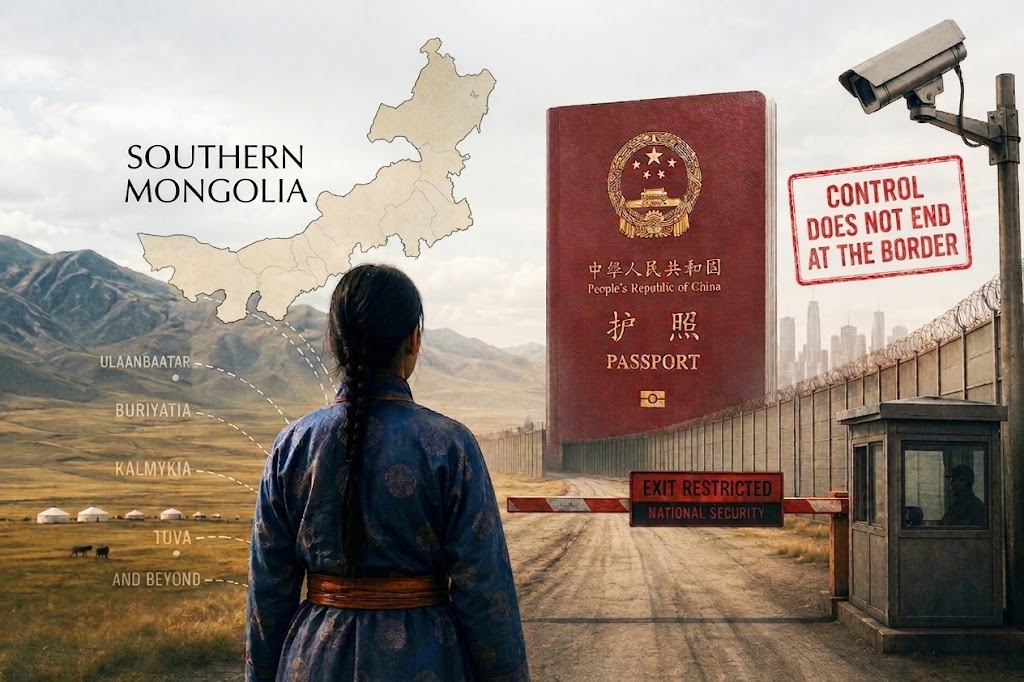
For most people, leaving their country is a basic freedom. A passport may be required, and border officials may conduct checks, but the basic assumption is that a citizen is free to travel.
Many of us who grew up in Southern Mongolian families, at home or abroad, know what it means when that assumption no longer holds. I think of sons and daughters who have not seen aging parents in years—not because they chose distance, but because a border crossing now carries a weight it did not used to carry. For many Southern Mongolians, that is no longer a hypothetical concern.
That freedom has increasingly become subject to state control.
China's new Regulations on Exit and Entry Administration, issued on July 31, 2026, will take effect on September 15. The regulations establish a new national framework governing the departure of Chinese citizens. But their significance cannot be understood from the text alone. They must be read against a longer record of restrictions on movement, particularly in China's ethnic minority regions.
The Restrictions Already Exist
The restrictions are not confined to Xinjiang or Tibet. They have also existed in Southern Mongolia for years.
In 2018, Radio Free Asia reported that teachers in Inner Mongolia were required to obtain official approval before traveling abroad, with some teachers already being required to surrender their passports.
The practice did not stay confined to a single sector or fade with time. By 2024, RFA reported that passport restrictions on teachers and other public employees had expanded further, with government workers increasingly required to hand over their passports for "safekeeping" and to obtain official approval before any trip abroad.
What makes these measures significant is precisely that a person need not be suspected of a crime or hold a dissenting view to be affected. They reach ordinary teachers and public employees simply because of who employs them.
Human Rights Watch has documented a much broader pattern. It reported in 2025 that Chinese authorities were increasingly restricting the right to leave the country, with particularly severe and longstanding passport restrictions in Tibetan and Uyghur areas. Applicants from these regions face extensive additional documentation requirements, multiple layers of approval, long delays, or denial of passports without valid reason.
This is not, in other words, an isolated policy touching a handful of individuals. It is a system — one in which the right to leave China has already become conditional on the state's permission, concentrated most heavily in the regions it regards as ethnically sensitive.
Why This Matters for Southern Mongolians
The consequences reach further than travel itself.
For many families, a border crossing is how relationships with relatives abroad are kept alive. The Southern Mongolian Human Rights Policy Act, introduced in the U.S. Congress, identifies this as a distinct human rights concern, noting that travel restrictions limit Southern Mongolians' ability to maintain ties with family and community in Mongolia and beyond.
Visiting aging parents, attending a family gathering, simply being present for the people who matter most: these are the ordinary acts that a restriction on travel puts at risk.
A restriction on travel, then, is not merely a restriction on travel. It is a restriction on connection itself.
Xinjiang and Tibet show where this can lead. In both regions, passport controls have gone far beyond preventing specific individuals from leaving — they have become a tool for constraining the movement of entire ethnic communities, often without a clear or transparent legal basis.
Southern Mongolia should not be treated as an exception simply because its restrictions have, so far, taken a different form. The underlying pattern is the same: where the state regards an ethnic community as politically sensitive, control over movement becomes part of a larger architecture of control.
A New Layer of Control
The 2026 regulations add a further dimension to this architecture.
Under the new rules, a Chinese citizen who, while abroad, engages in illegal or criminal activity later determined to have "endangered national security and interests" may, upon returning to China, be barred from leaving again for six months to three years.
The concern here is not that every restriction imposed under this provision would necessarily be unjustified. It is the breadth of the standard itself.
What, precisely, constitutes an activity that "endangers national security and interests"? Who decides? And what recourse does a citizen have when the basis for restricting their movement is neither clear nor disclosed?
These are not abstract questions. China's existing exit-and-entry law already permits authorities to bar citizens from leaving when they are deemed capable of endangering national security — a standard Human Rights Watch has criticized as too vague to meet international requirements that restrictions on freedom of movement be necessary, proportionate, and non-discriminatory.
The new regulation does not invent exit controls. What it does is formalize and strengthen a system in which a single, broadly worded national security standard can determine whether a citizen is allowed to leave — a standard that will apply within a country where ethnic minorities have already experienced disproportionate restrictions on movement, expression, religion, and cultural life.
When the Border Does Not End the Pressure
The most striking feature of the new regulation is that the border does not stay behind. What a person does abroad can now follow them home—and decide whether they are allowed to leave again.
The regulation does not state that criticism of the government, journalism, or peaceful cultural advocacy automatically qualifies as activity that endangers national security. That distinction matters, and it should not be erased.
But Southern Mongolian history gives reason to take the broader issue seriously.
These are not distant statistics. They are names many in our community know.
The Southern Mongolian Human Rights Policy Act states that Chinese authorities have subjected Southern Mongolians to transnational repression, and that at least five Southern Mongolian dissidents living in exile have been forcibly returned to China since 2009. It specifically cites the case of Lhamjab Borjigin, a Southern Mongolian writer and historian who was detained by Chinese police in Ulaanbaatar on May 3, 2023, and returned to China the same day.
The legislation also documents the case of Hada, who was sentenced to 15 years in prison in 1996 and held for another four years after his sentence expired. He was later placed under house confinement. His wife, Xinna, and their son, Uiles, were also imprisoned.
These cases predate the 2026 regulations. They are not evidence that the new rules were used against them. What they demonstrate is something else:
For Southern Mongolians, crossing an international border has not necessarily meant escaping the reach of Chinese state control.
The new rules create one more link between what a person does abroad and what happens to them after they come home.
The Question Is Accountability
The issue, at bottom, is not that China has rules governing who may leave the country. Every state does.
The more serious question is how such power is exercised.
The U.S. Department of State currently warns travelers to China about the “arbitrary enforcement of local laws, including in relation to exit bans,” cautioning that Chinese authorities may impose such bans without a clear or transparent process for resolving them.
That warning goes to the heart of the matter. The question is not whether a state may ever regulate its borders — it is whether restrictions on a citizen's movement are clearly defined, necessary, proportionate, non-discriminatory, and subject to meaningful review.
For Southern Mongolians, that question cannot be separated from the record already in place: passport restrictions reaching teachers and public employees across Southern Mongolia; and cases in which Southern Mongolian writers and activists have been detained, confined, or forcibly returned from abroad.
The new regulations should be read not only for what they formally prohibit, but for how they are likely to operate within a system of control that already exists.
That is why this is more than a travel policy. It is a question of who controls a person's ability to leave, what standards are used to make that decision, and whether the citizen has any meaningful protection when the state says no.
More Than Movement
The questions raised across this series now converge.
Language shapes what a people inherits. Identity shapes what it seeks to preserve. Movement determines whether those inherited, preserved connections can continue across borders that divide a transnational community.
For Southern Mongolians, freedom of movement was never simply the freedom to travel. It is the freedom to visit family, maintain cultural and religious ties, take part in the wider Mongolian community, and remain connected to a world beyond the reach of a single state.
When that freedom can be withheld through powers that are broad, opaque, and difficult to challenge, the border stops being simply a line on a map.
For those of us who call ourselves Southern Mongolian, wherever we live, the border becomes another instrument of control.
Sources
- Radio Free Asia — rfa.org
- Human Rights Watch — hrw.org
- U.S. Congress, Southern Mongolian Human Rights Policy Act — congress.gov
- U.S. Department of State travel advisory — travel.state.gov
- China's State Council, Regulations on Exit and Entry Administration (issued July 31, 2026)