A Language Is Not Just Words: Why Mongolian Language Rights Matter
By Borjigin Manda
An ongoing opinion series exploring Southern Mongolian identity, language, culture, history, and the broader questions of cultural preservation and diversity.
Read the Series
Borjigin Manda is the founder and editor of Southern Mongolian News. As a Southern Mongolian, he writes about language rights, cultural preservation, and public policy affecting Southern Mongolia, with a focus on documenting cultural identity and promoting greater understanding of the experiences of Southern Mongolians.
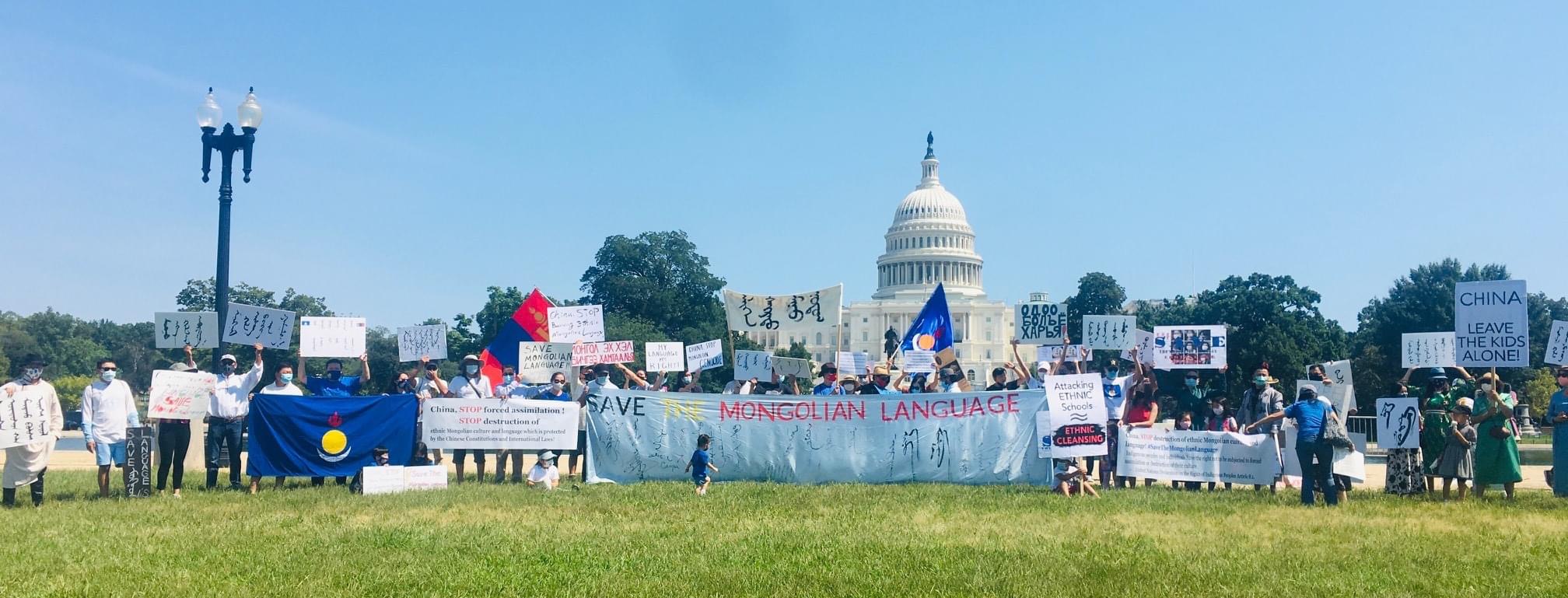
Southern Mongolian supporters gather in Washington, D.C., on September 7, 2020, to protest China’s changes to Mongolian-language education policies in Southern Mongolia.
In early September 2020, classrooms across Southern Mongolia became unexpectedly quiet.
Thousands of Southern Mongolian students stayed home from school. Parents refused to send their children back to class. Teachers found themselves caught between official directives and their own concerns about the policy.
What began as an education policy change soon became one of the most significant public protests by Southern Mongolians in recent decades.
At the center of these protests was a question far greater than a school curriculum:
What happens when a people begin to lose the language that has carried their history for centuries?
For many Southern Mongolians, the controversy over Mongolian-language education was not simply about classroom instruction. It represented a much deeper question about the future of a cultural identity that had been maintained through generations.
A language is not simply a tool for communication.
It is a connection between generations.
It carries stories, literature, traditional knowledge, and collective memory. Through language, people pass down their understanding of history, their relationship with the land, and their ways of seeing the world.
For Southern Mongolians, the Mongolian language has served this role for centuries. It is not only a means of speaking. It is part of the foundation through which a community understands its history, identity, and place in the world.
This is why language rights are not merely an educational issue.
They are about whether a community has the ability to preserve and develop its own cultural heritage.
When Language Policy Shapes Identity
Around the world, language has long been recognized as a fundamental part of identity.
UNESCO has emphasized the importance of mother-tongue education, particularly for minority communities, recognizing that language plays a central role in learning, cultural confidence, and social participation. The United Nations Declaration on the Rights of Indigenous Peoples also recognizes the right of indigenous peoples to maintain, develop, and transmit their languages to future generations.
A language survives not only because people speak it at home.
It survives because children can learn it in schools.
It survives because books can be published in it.
It survives because it has a place in public life.
For minority communities, education is one of the most important institutions determining whether a language continues to grow or gradually loses its role in society.
This is why language policy is never only about classrooms.
It is also about culture, identity, and the future of a community.
The 2020 Mongolian Language Education Protests
For many years, Mongolian language education had been an important part of the educational system in Southern Mongolia. Mongolian students studied their own language, literature, history, and culture while also learning Mandarin and other subjects.
The issue was never whether Mongolian students should learn Mandarin.
The issue was whether the development of one language should come at the expense of another.
In 2020, changes to Mongolian-language education policies became a turning point for many Southern Mongolians. The policy replaced Mongolian with Mandarin as the primary language of instruction in schools, fundamentally changing the role of Mongolian in the education system.
For many families, this was not simply a change in classroom instruction. It raised a deeper question about whether future generations would continue to have meaningful opportunities to learn and use their own language.
Peaceful demonstrations took place throughout Southern Mongolia, while overseas Southern Mongolian communities also organized public protests and solidarity activities.
The issue quickly attracted international attention. Human Rights Watch reported that the policy changes would further restrict Mongolian-language education and weaken opportunities for Mongolian students to receive meaningful education in their mother tongue. The Congressional-Executive Commission on China and other human rights organizations also documented broader concerns regarding pressures on ethnic minority languages and cultural expression in China.
For many Southern Mongolians, the 2020 education changes became a symbol of a larger question:
If children can no longer learn their own language in school, where will that language survive?
Beyond the Classroom
The importance of a language is not measured only by whether people are technically allowed to speak it.
A language needs space.
It needs schools where children can learn it.
It needs books and publications.
It needs public visibility.
It needs a social environment where young people feel that their language belongs not only to the past, but also to the future.
For many Southern Mongolians, the impact of language policy has extended beyond classrooms. They have also included changes affecting textbooks, public signs, cultural institutions, and the broader presence of the Mongolian language in daily life.
When a minority language gradually loses its role in education and public expression, the impact reaches far beyond words.
Young people may become increasingly disconnected from historical writings, traditional knowledge, and older generations who carry cultural memory.
A language is not lost only when people stop speaking it.
It is weakened when people lose the opportunity to use it naturally in their everyday lives.
From the Grassland to Cultural Preservation
My understanding of cultural preservation was shaped by my years working on grassland environmental protection and alongside Mongolian pastoralists.
During that time, I also participated in efforts to educate and support herders on issues affecting their livelihoods and rights. Through that experience, I learned that culture cannot be separated into isolated parts.
The grassland, traditional knowledge, community life, and language are deeply connected.
Among Mongolian pastoralists, language carries knowledge about nature, seasons, animals, and relationships between people and the land. Many expressions contain generations of accumulated experience that cannot simply be translated into another language without losing part of their meaning.
This experience shaped my understanding that protecting culture is not about preserving something frozen in the past.
It is about protecting a living relationship between people, their history, and their environment.
In 2020, I participated in peaceful demonstrations in support of Mongolian language education and cultural rights as part of the broader Southern Mongolian response to these changes. Like many Southern Mongolians who spoke out at that time, I believed that the future of a language should not be determined only by government policy.
A language survives because people continue to value it, teach it, and pass it to the next generation.
That belief has also influenced my work today.
Through Southern Mongolian News, I continue documenting issues related to language, culture, history, and the experiences of Southern Mongolians. Writing is another way of preserving memory and ensuring that the voices of communities are not forgotten.
A Language Is a Living Future
Every society changes, and every community must adapt to a changing world.
Learning additional languages and participating in broader society are important parts of education and development.
But modernization should not require a community to abandon the language that connects it to its own history.
Around the world, many societies have shown that cultural diversity and social development can exist together. A strong society does not need cultural uniformity in order to achieve stability and harmony.
The future of the Mongolian language depends on whether future generations have meaningful opportunities to learn it, use it, and continue developing it.
A language survives when people are able to live with it — not only remember it.
Governments can change textbooks. They can redesign curricula. They can even reduce the public space where a language is spoken.
But no policy can erase a language as long as people continue to speak it, teach it, and defend its place in public life.
That is why I continue to write — not because language belongs to the past, but because its future is still worth defending.
Because a language is not just words.
It is memory.
It is identity.
It is the voice of a people.
Sources
- UNESCO — Mother Tongue and Multilingual Education
- United Nations Declaration on the Rights of Indigenous Peoples — Articles 13 and 14
- Human Rights Watch — China: Mongolian Mother-Tongue Classes Curtailed (2020)
- Congressional-Executive Commission on China (CECC) — Reports on ethnic minority language policies
- Reuters — Coverage of the 2020 Mongolian language education protests
- Amnesty International — Reports on ethnic minority cultural and linguistic rights in China