The Grassland Is More Than Land: Environmental Protection, Community, and Herders' Rights
By Borjigin Manda
An ongoing opinion series exploring Southern Mongolian identity, language, culture, history, and the broader questions of cultural preservation and diversity.
Read the Series
- Part I — Unity Cannot Be Built on Assimilation: Why I Oppose China's Ethnic Unity Law
- Part II — A Language Is Not Just Words: Why Mongolian Language Rights Matter
- Part III — When the Border Follows You: China's New Exit Rules and Southern Mongolians
- Part IV (Personal Story) — The Grassland Is More Than Land: Environmental Protection, Community, and Herders' Rights
- Part V (Personal Story) — Coming Soon
Borjigin Manda is the founder and editor of Southern Mongolian News. As a Southern Mongolian, he writes about language rights, cultural preservation, and public policy affecting Southern Mongolia, with a focus on documenting cultural identity and promoting greater understanding of the experiences of Southern Mongolians.
Author's Note: This essay draws on my experience in grassland environmental protection and community work in Southern Mongolia since the early 2000s.
For pastoral communities, the grassland is not merely a natural resource. It is where livelihoods, communities, and generations of knowledge are rooted.
When a grassland is polluted or taken over, what exactly is lost?
The question becomes more urgent when you witness it happening. Not in the abstract, but in the fields where herders live. Not as an environmental statistic, but as a family's disrupted livelihood. Not as a policy problem, but as land that can no longer sustain the animals and people who depend on it.
For more than two decades, I have watched this unfold in Southern Mongolia. What I learned was not simply that grassland deserves protection. I learned that environmental protection—real, meaningful protection—requires something most people do not initially recognize: it requires that communities understand the rules governing their land, that they can organize to defend it, and that they have space to discuss what is happening to them.
Legal Knowledge and the Beginning of Community Action
In the early 2000s, grassland environmental degradation in Southern Mongolia was visible and accelerating. Industrial pollution, water depletion, overgrazing in some areas, land fragmentation—these were concrete realities that herders faced daily.
Yet alongside visible degradation, a fundamental gap existed: many herders living on polluted or threatened grassland did not have meaningful access to legal knowledge that might help them respond.
Chinese law does protect grasslands. The legal framework contains substantive provisions on environmental protection, land rights, rural land contracting, and government information disclosure. But these laws existed in Chinese —a language many herders did not read fluently. Local herders operated at a structural disadvantage: they could observe that their land was being damaged, but they could not easily determine what legal tools existed, what procedures to follow, or what rights they might assert.
This gap between environmental reality and legal knowledge became the starting point for different work.
Beginning in the early 2000s, a collaborative effort emerged to translate key Chinese legal materials into Mongolian. The work was focused and practical: translating laws concerning grassland protection, land rights, rural land contracting, environmental protection, and government information disclosure. The goal was straightforward—to make legal knowledge accessible in languages herders actually used.
The scale of this effort was significant. Organized by Echoing Steppe, Friends of Nature, and Taliinhan, approximately 38 volumes of legal and environmental education materials, totaling roughly 80,000 copies, were translated, printed, and distributed freely to pastoral communities across Southern Mongolia. I was directly involved in compiling and distributing many of these Mongolian-language legal materials.
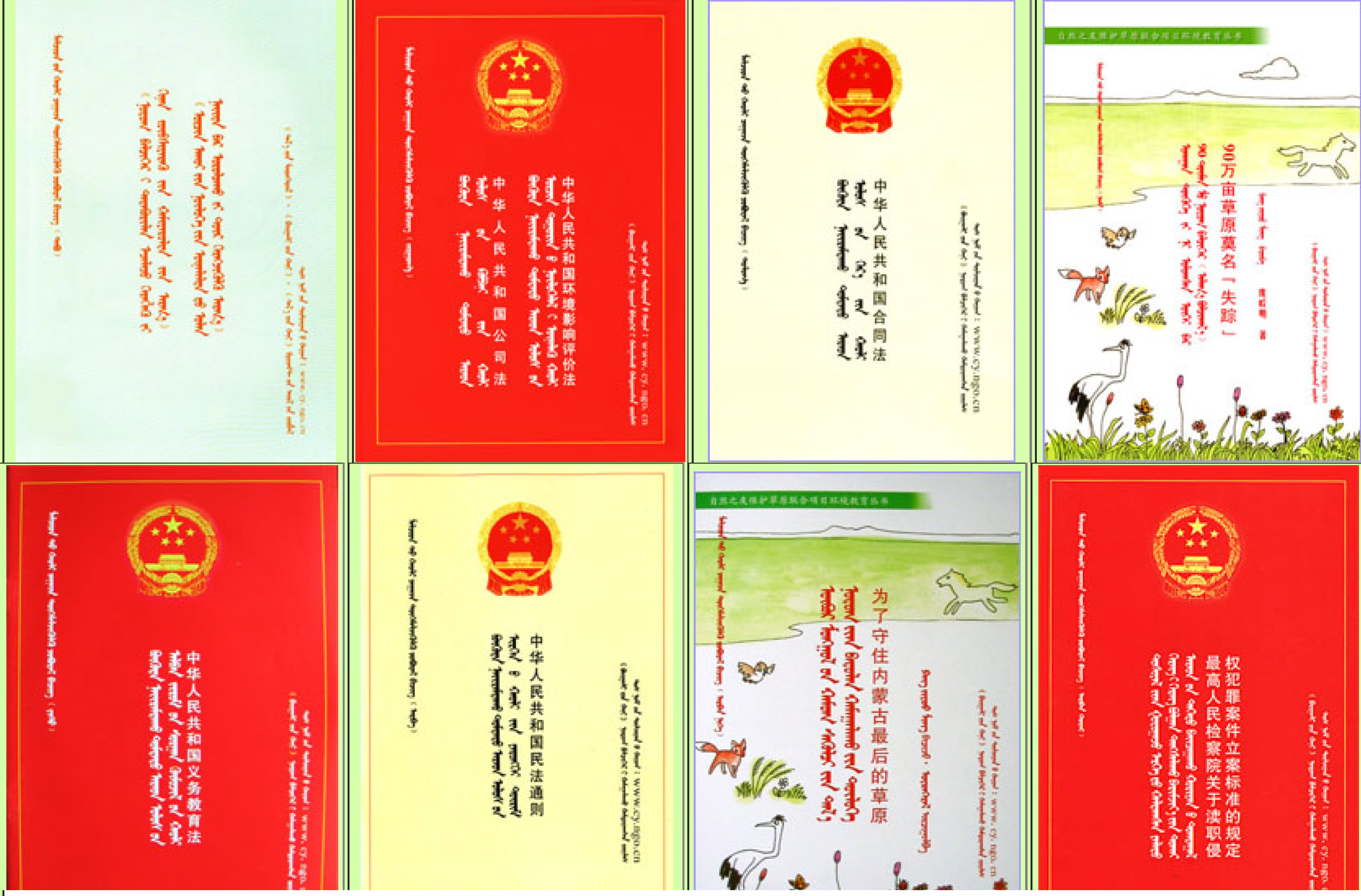
Mongolian-language legal and environmental education materials distributed to pastoral communities in Southern Mongolia.
I remember the experience vividly. I would bring legal and environmental books into pastoral communities and watch herders read materials that directly addressed problems they faced in their own fields. A herder dealing with water pollution could read, in Mongolian, the relevant environmental protection law. A community concerned about land tenure could access materials on grassland ownership rights. The work was simple in mechanics — translate, print, distribute — but foundational in purpose: to place legal knowledge into the hands of people who needed it to defend what was theirs.
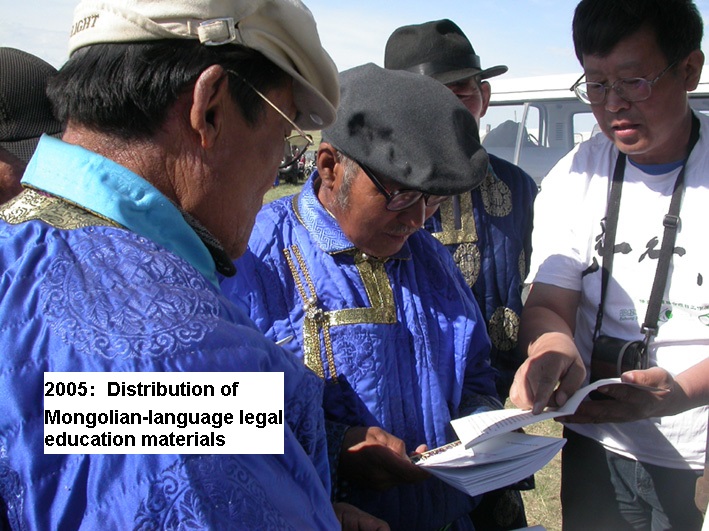
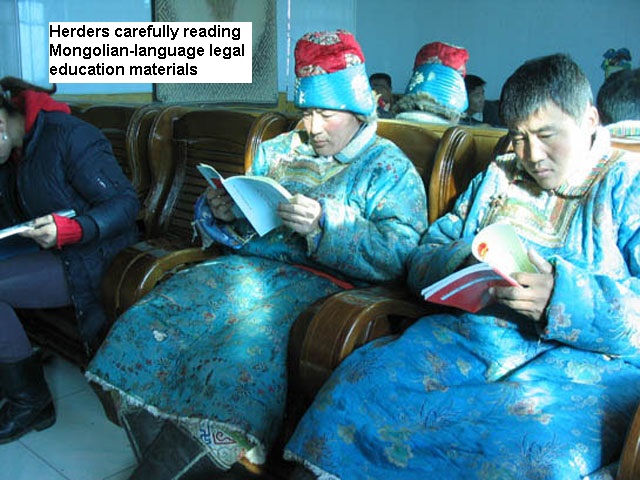
The significance lay in the logic underlying it: environmental protection cannot be separated from access to legal knowledge. When people do not understand the legal framework governing their land, when they cannot access that framework in a language they speak, they cannot effectively defend themselves. They remain dependent on external advocates rather than becoming active participants in their own defense.
I also came to understand how legal knowledge transforms environmental problems. A herder observing pollution might begin with a simple question: "What is wrong with my land?" With access to legal materials, that observation becomes precise: "What environmental law applies? Who is legally responsible? What documentation should exist? What procedure do I follow?" Knowledge converts observation into actionable claim.
In June 2005, this foundational legal education work crystallized into organized community action. I was present when an ecological protection seminar brought together herders, environmental advocates, lawyers, and researchers to discuss grassland degradation, community land rights, and possibilities for collective organization.
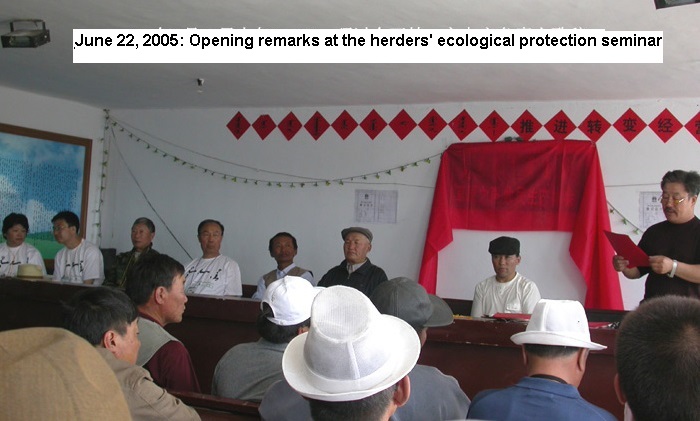
Participants at an ecological protection seminar in June 2005 discuss grassland degradation, pastoral land rights, and community responses.
From this gathering emerged one of the first herder-led environmental organizations in the region, called "Voice of the Grasslands."
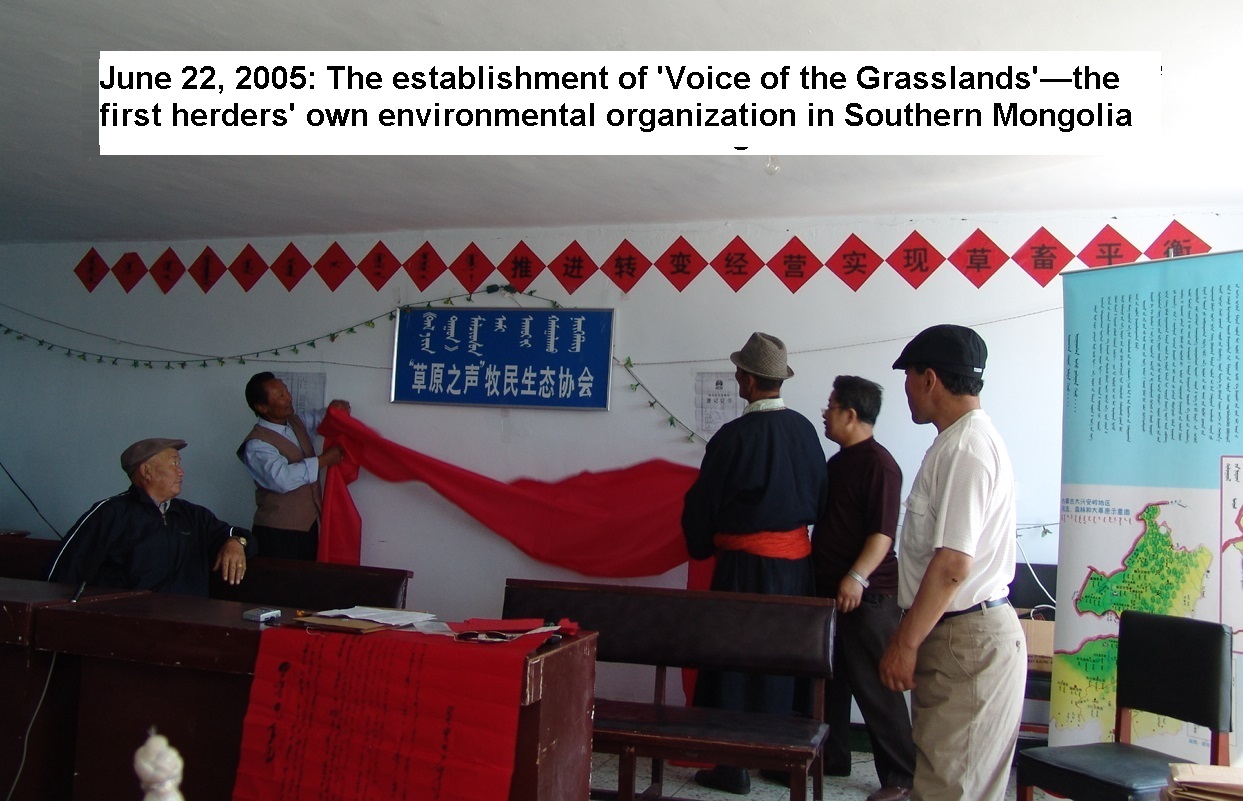
The unveiling of “Voice of the Grasslands,” a herder-led environmental organization established in Southern Mongolia in 2005.
The importance of this moment was not that it solved problems immediately. Rather, it marked a shift in consciousness: from individual environmental concern to collective recognition that herders could organize around their shared environmental interests and become active agents in defending their land.
The photographs I kept from that day are meaningful to me because they capture that transition. They show people gathered not simply to listen to experts, but to discuss how their own communities could respond to problems affecting their land and livelihoods. I was present, and I witnessed the beginning of organized community action — herders engaged with each other and with advocates, beginning to see themselves as a collective force rather than as isolated individuals facing powerful industrial projects and government decisions.
This was the beginning of understanding that environmental protection required more than caring about nature. It required knowledge. It required organization. It required herders being able to see themselves as having a stake in defending what was theirs.
When Pollution Became a Question of Rights
The question of what environmental protection actually means became clear to me through a specific case.
In the East Ujimqin region, herder Damrenjab and other local herders faced severe pollution from a paper mill. Industrial wastewater was discharged onto pastoral land, damaging the grassland and affecting the livelihoods of herding families. The pollution led to years of legal disputes as the herders sought to protect their land and hold the mill accountable.
Records of the dispute were later preserved in Taliinhan forum, documenting the pollution, grassland degradation, livestock losses, and the community’s efforts to pursue legal remedies.
2000: The Pollution Begins
In 2000, the East Ujumqin Paper Mill began operations. Almost immediately, it began discharging wastewater directly onto the grassland.
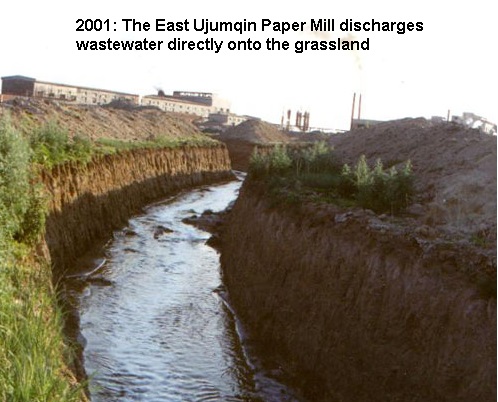
Wastewater from the East Ujimqin Paper Mill flowing onto pastoral land, documenting the industrial pollution that affected local grasslands.
The discharge marked the beginning of an environmental crisis that would severely affect the grassland and local herding communities.
2002: The Grassland Transformed
By 2002, continuous discharge had accelerated. Vast sections of previously productive grassland had transformed into dark pools of industrial wastewater. Herders, witnessing the destruction of their pasture with no government intervention, made a collective decision: they would pursue legal action.
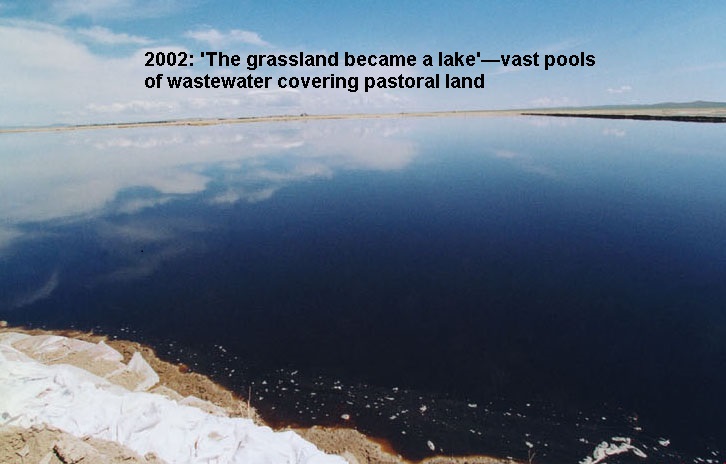
Industrial wastewater covering previously productive grassland in East Ujimqin, illustrating the extent of environmental damage reported by local herders.
Damrenjab and other affected herders sued the paper mill operator, asserting their legal rights under Chinese environmental protection law and land use regulations. They could do this because legal knowledge circulating in pastoral communities had enabled them to understand they had legal grounds to challenge the pollution.
2004: Legal Victory
The case proceeded through formal legal channels, with evidence of pollution and legal arguments presented to the court. In 2004, Inner Mongolia High People’s Court issued its judgment: the herders prevailed, liability was established, and the paper mill was ordered to relocate and pay compensation.
On paper, the legal system had functioned as it should. Justice appeared to have been served.
2005: When Victory Does Not Restore What Was Lost
But the court judgment did not resolve the environmental crisis. The paper mill relocated as ordered, but the polluted grassland remained. The herders waited for restoration to begin. It did not.
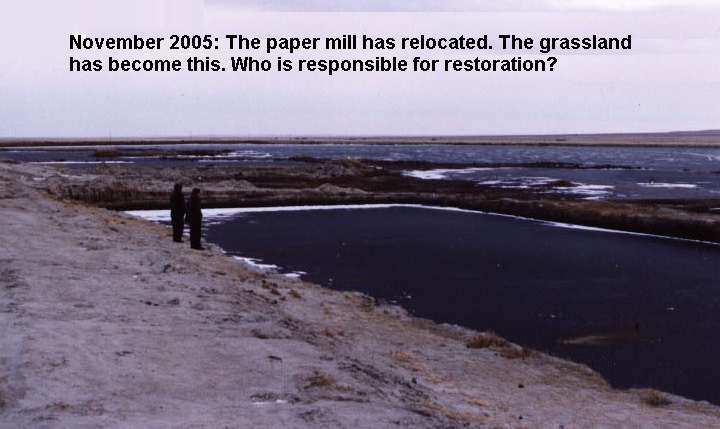
November 2005: Wastewater pools remained on the grassland one year after the court judgment ordering the paper mill to relocate.
Without a responsible party legally obligated to restore it, who would undertake the cleanup? How long would it take for the land to recover? This was the gap between legal judgment and environmental reality.
2007: The Unresolved Crisis
Three years after winning the court case, six years after the pollution began, the situation remained unchanged. The wastewater pools persisted. The grassland was still black, still contaminated, still impossible to use for herding.
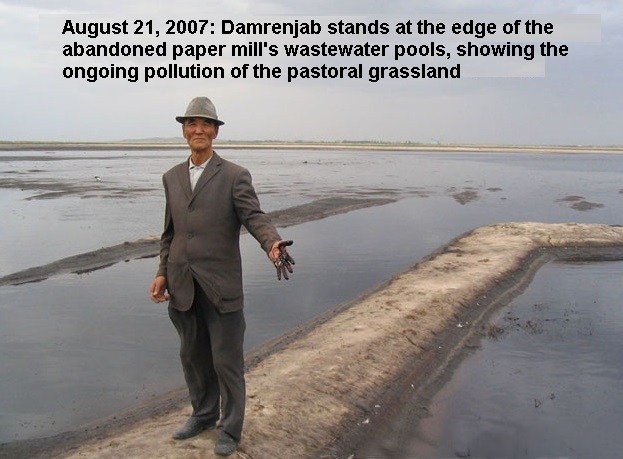
August 2007: Damrenjab stands beside the contaminated grassland in East Ujimqin, where wastewater pools remained six years after the pollution began.
Years after the legal judgment, the reality on the ground remained difficult to ignore. Large areas of grassland were still heavily polluted, with black wastewater and black mud covering the land, leaving behind a landscape that could take many years to recover, if recovery was possible at all.
This gap between legal victory and environmental restoration raised a question that legal judgments cannot answer: What does environmental justice mean if a legal victory does not restore the land?
The Damrenjab case was not exceptional. Throughout the early and mid-2000s, similar disputes emerged in different areas: industrial pollution affecting pastoral use, water contamination, mining and reclamation affecting grasslands, conflicts between herding livelihoods and industrial development. Each case followed a similar pattern: problem identified, legal proceeding initiated, judgment issued, but the fundamental restoration of the damaged environment remained incomplete or uncertain.
What these cases revealed was crucial. Environmental protection, viewed from the perspective of affected communities, involves more than environmental remediation. It involves the ability to understand what is happening, to organize a collective response, to document the problem, to pursue remedies, and crucially, to monitor whether those remedies actually work. It requires communities not as passive subjects in legal proceedings, but as active participants who can understand the rules, assess outcomes, and continue to defend their interests.
The legal framework protecting grasslands is necessary. But it is not sufficient.
From Legal Knowledge to Community Defense
If environmental protection required legal knowledge and community organization, what would this actually look like in practice?
The answer involved multiple interconnected elements. Mongolian-language legal education materials circulated in pastoral areas, allowing herders to understand applicable laws. Herder organizations formed, providing a structure for collective discussion and action. Advocates worked with volunteer lawyers to help communities pursue land rights—including the pursuit of collective grassland ownership certificates, which gave communities formal legal claim to specific grassland areas and a voice in land-use decisions.
I was directly involved in this work. Through seminars and community activities, I saw herders discuss ecological and land issues with researchers, lawyers, and one another. What stood out to me was the change in the questions being asked: environmental concerns were increasingly being expressed not only as problems affecting the grassland, but as questions of land ownership, contracting rights, and legal remedies.
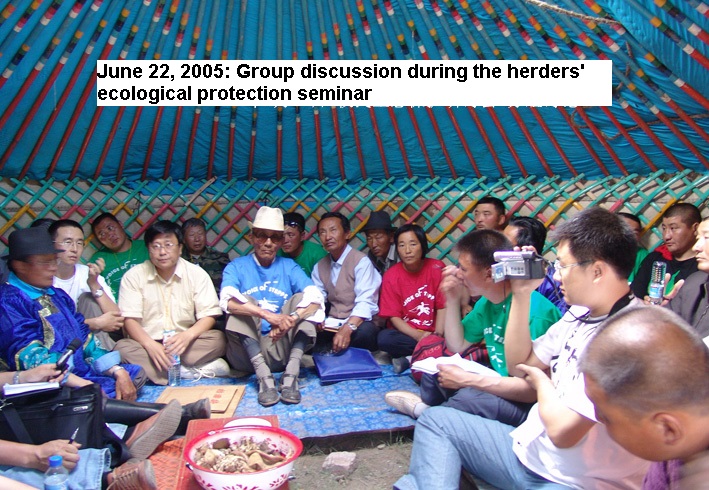
Herders and environmental advocates discuss grassland protection, land rights, and community responses at a regional environmental seminar.
The first herder environmental symposium brought together representatives from different pastoral areas to discuss environmental challenges and share experiences about community responses, and build networks of information exchange.
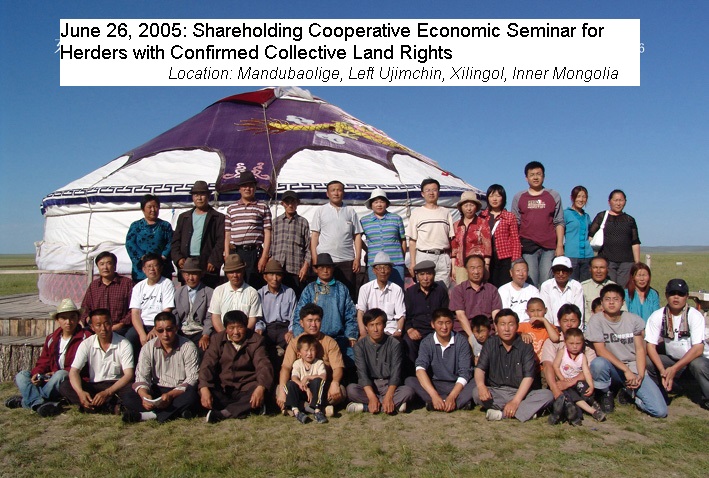
Herders from different pastoral regions gather to discuss collective land rights, economic cooperation, and community experiences.
Beyond seminar-based efforts, practical information stations were established in some pastoral communities where herders could access legal and environmental materials. Computer training programs were also introduced, with Mongolian-language training materials developed to help herders use computers and access information.
These efforts gave herders new ways to access, share, and exchange information beyond their immediate communities.
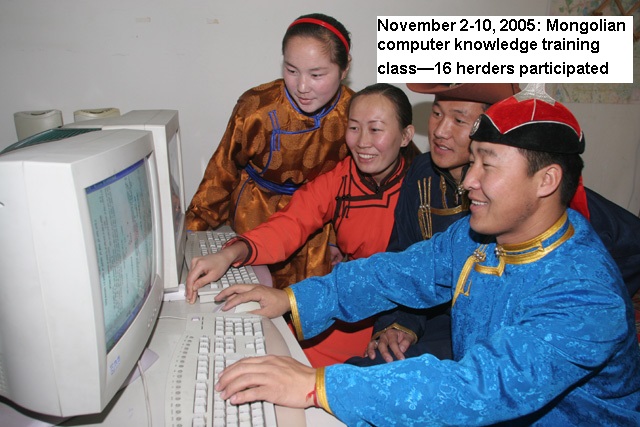
Computer training for pastoral communities, including instruction in basic computer skills and access to information resources.
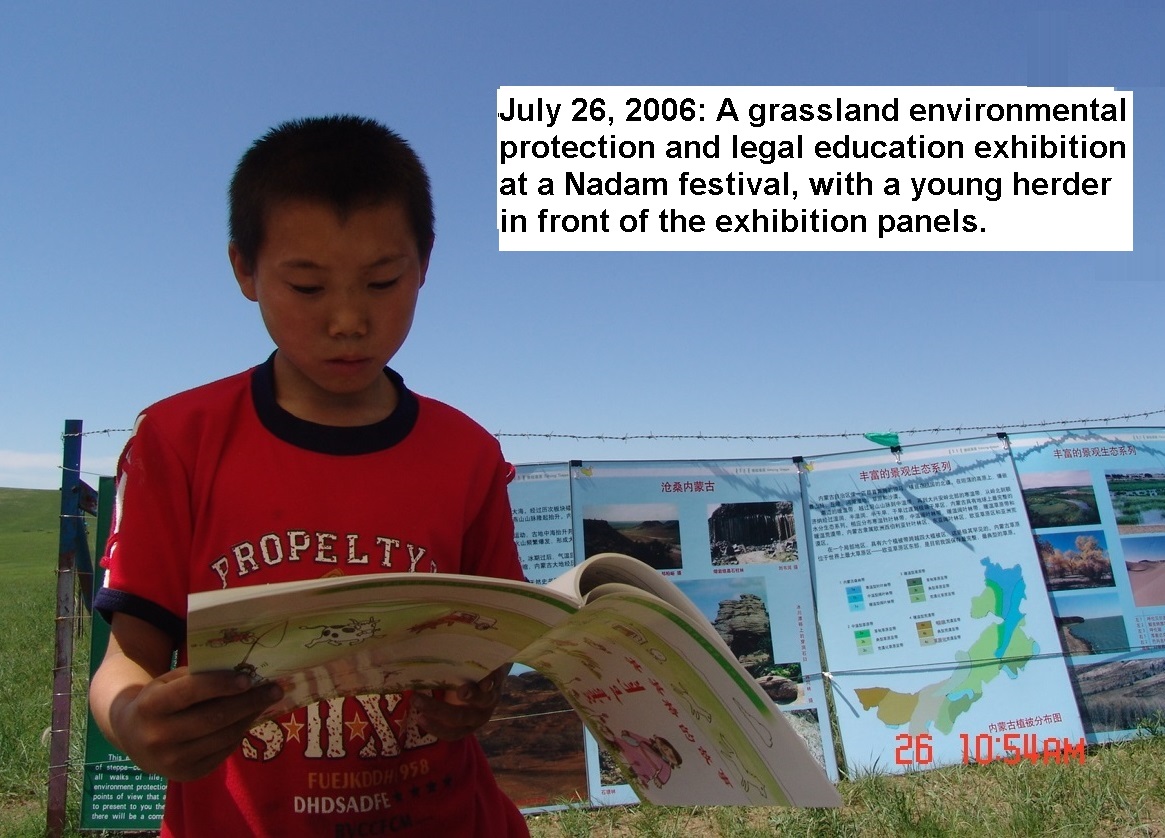
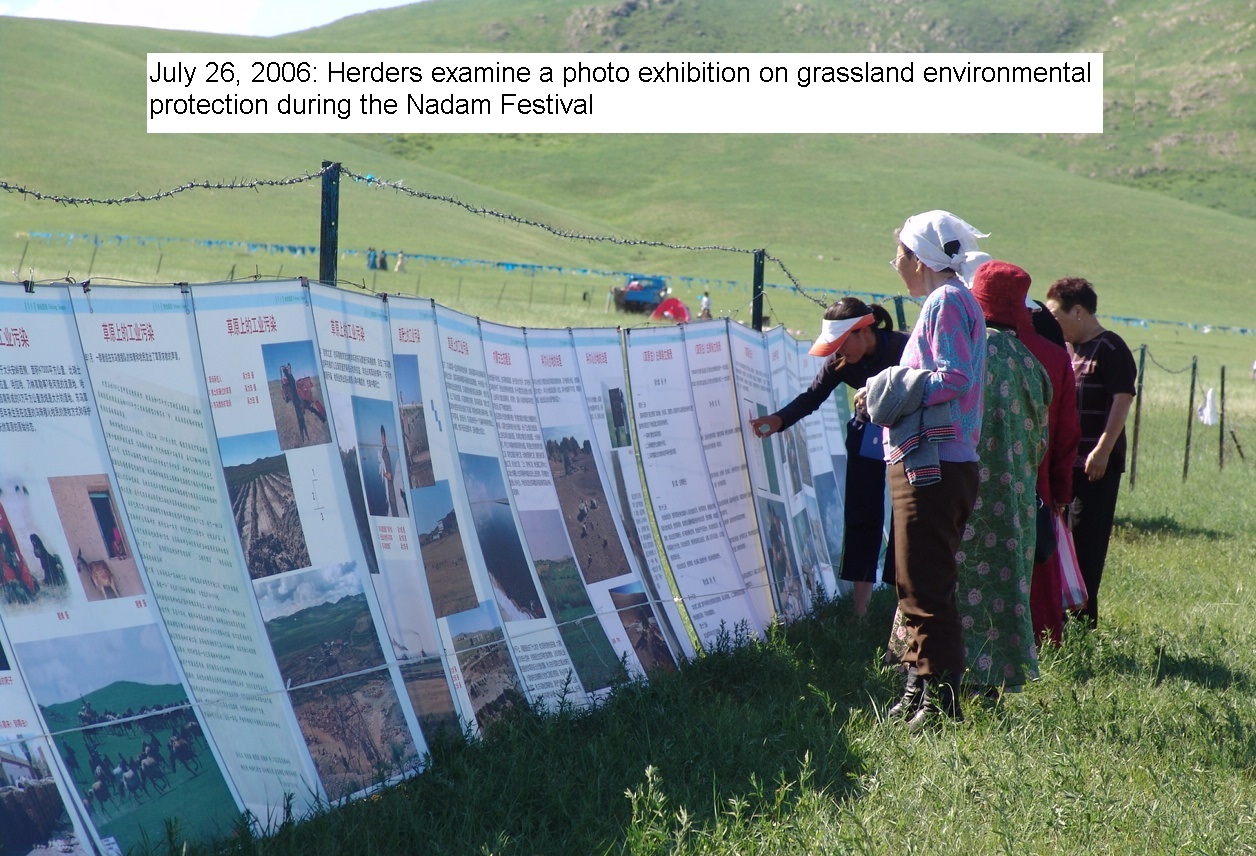
Furthermore, during community gatherings such as the Nadam festival, law education exhibitions were set up to bring legal materials directly to herders in accessible, informal settings.
The underlying logic was straightforward: know the law → organize → defend the land.
This was not simply environmental activism. It was the building of capacity — enabling communities to understand their legal position, recognize shared interests, organize collectively, and act on their own behalf rather than depending on external advocates.
For a herder confronting industrial pollution, understanding applicable environmental law was not academic. It was practical. It meant knowing what standards applied, what procedures existed, what compensation could be demanded, which government agencies had responsibility. It meant asking informed questions rather than accepting whatever response authorities offered.
For a herding community, collective organization meant that environmental problems affecting one family could be understood as affecting the entire community's survival. It enabled coordinated response, information sharing about what worked or failed elsewhere, and a collective voice in negotiations rather than isolated individuals facing more powerful actors.
For a region, legal knowledge circulation and community organization meant environmental problems could no longer be treated as isolated incidents affecting individual families. They became visible, discussable, part of patterns that entire communities could collectively understand and respond to.
When Even Information Became Sensitive
But the effectiveness of this approach—legal education, community organizing, collective documentation—quickly encountered political constraints.
In 2008, local public security authorities confiscated Mongolian-language legal handbooks and educational materials related to grassland protection, classifying them as “illegal publications.” The confiscation was documented in a Taliinhan forum post with a detailed list of the materials taken, and the incident was later reported by Radio Free Asia.
The political significance was troubling and clarifying: even basic environmental education could become politically sensitive. When communities began using legal knowledge to assert rights and question official environmental decisions, when they began documenting damage and demanding accountability, the provision of legal knowledge itself became treated as problematic.
This raised a practical question: if communities needed legal knowledge to defend their land, but providing that knowledge could result in confiscation and official pressure, how could the work continue? How could communities maintain and share accumulated knowledge? How could experiences and lessons be preserved and shared across pastoral regions?
The answer was not yet visible at that moment. But it was becoming clear that environmental protection could not rely solely on face-to-face meetings, legal clinics, and printed materials that could be confiscated. It required something different: a space where information could be preserved, discussions could continue, and community knowledge could accumulate.
This realization led to a different phase of the work—one depending less on physical materials and more on digital platforms where information could be stored, shared, and preserved.
Conclusion
Over these years of participation in grassland environmental protection, I came to understand that the work involved layers that many environmental advocates do not immediately recognize.
The first layer was simple awareness: grasslands are being degraded, and the communities that depend on them are suffering real losses.
The second layer was understanding: environmental protection requires that communities access legal knowledge, understand applicable rules, and know what procedures exist to defend their interests. This knowledge must be available in languages communities speak and read. Without it, communities cannot effectively assert their rights.
The third layer was organization: environmental protection requires communities to recognize shared interests, organize collectively, and develop capacity to respond to environmental harm as organized communities rather than as isolated individuals. This is how power is built—through coordination, communication, and collective action.
But these first three layers revealed a fourth requirement: preservation and discussion. Communities need a space where they could document what is happening to their land, discuss problems across different regions, preserve and share knowledge about how other communities have responded to similar threats, and maintain collective memory of what has been lost, what has been tried, and what has failed.
Without that space, each community faces its environmental problems in isolation. Without that space, knowledge hard-won through years of experience can be lost. Without that space, the conversations about rights, about land, about justice , about accountability can be silenced or forgotten.
This is where the next part of this story continues.
Sources
- Echoing Steppe. Grassland and Environmental Protection Legal Resources.
- Taliinhan Forum. Case Discussion—Inner Mongolia High People’s Court Second-Instance Judgment in the East Ujimqin Paper Mill Pollution Case.
- Taliinhan Forum. Volunteer Legal-Education Handbooks Confiscated by the West Ujimqin Public Security Bureau as “Illegal Publications”.
- Radio Free Asia. Richard Finney, Advocate for Inner Mongolian Herdsmen in “Failing Health” in Jail, September 3, 2013.
- Radio Free Asia. Inner Mongolian Environment Threatened, Nomads Forced To Move, February 7, 2005.