Unity Cannot Be Built on Assimilation: Why I Oppose China's Ethnic Unity Law
By Borjigin Manda
An ongoing opinion series exploring Southern Mongolian identity, language, culture, history, and the broader questions of cultural preservation and diversity.
Read the Series
Borjigin Manda is the founder and editor of Southern Mongolian News. As a Southern Mongolian, he writes about language rights, cultural preservation, and public policy affecting Southern Mongolia, with a focus on documenting cultural identity and promoting greater understanding of the experiences of Southern Mongolians.
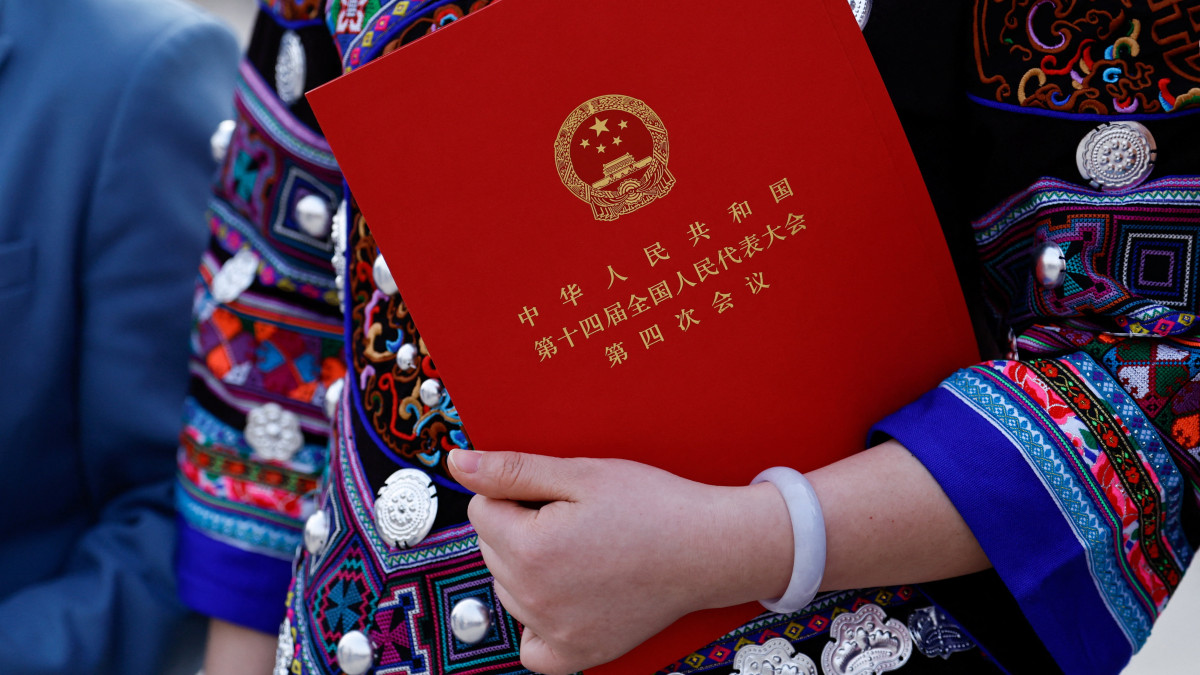
A delegate in ethnic minority costume holds a document following the closing session of the National People’s Congress (NPC) at the Great Hall of the People in Beijing, China March 12, 2026. REUTERS/Tingshu Wang
In July 2026, China’s Law on Promoting Ethnic Unity and Progress officially came into effect. Chinese authorities describe the law as an important measure to strengthen ethnic unity, national cohesion, and development among China’s ethnic groups.
However, for many Southern Mongolians, this law raises a fundamental question:
What kind of unity is being created?
Is it a unity based on mutual respect, equality, and the protection of different cultures? Or is it a unity achieved by requiring ethnic minorities to gradually abandon their languages, traditions, historical memories, and identities in order to fit into a single officially defined national narrative?
A society’s approach toward its ethnic communities reflects how it understands diversity, identity, and equality. When a government introduces a law in the name of “ethnic unity,” the world should expect that such a law protects cultural diversity, respects historical differences, and allows different communities to maintain their heritage with dignity.
As a Southern Mongolian, I believe this law represents a deeply troubling shift in the future of our linguistic and cultural identity.
Rather than strengthening genuine harmony among different peoples, it risks providing a stronger legal foundation for policies that weaken ethnic minority identities, reduce cultural space, and place a single national identity above the languages, histories, and traditions of different communities.
This is why I oppose China’s Ethnic Unity Law.
My opposition is not based on hostility toward any people. It is not a rejection of cooperation, peaceful coexistence, or communication between different communities.
It is based on a simple principle:
True unity cannot be created by asking one group of people to gradually lose the language, culture, and history that define who they are.
For generations, Mongolians in Southern Mongolia have maintained a unique language, historical experience, and cultural tradition. These are not political symbols. They are the living heritage of a people.
A language is not merely a tool of communication. It carries the memories, values, literature, philosophy, and worldview of a community. It connects generations and allows people to understand where they come from.
When a language loses its place in education, public life, and the lives of younger generations, the consequences extend far beyond communication. A community’s ability to maintain its identity is placed at risk.
In recent years, Mongolian language education has faced an accelerating process of dismantling. What began as restrictions on bilingual education has evolved into the systematic replacement of Mongolian as a language of instruction, depriving many Mongolian children of the opportunity to receive an education in their mother tongue.
The introduction of this law has further reinforced these trends by providing broader legal support for policies that reshape ethnic identity and cultural expression.
The issue is not whether different ethnic groups should live together peacefully.
Of course they should.
The issue is whether peace and unity can truly exist when one culture is increasingly expected to replace others.
True unity does not require everyone to become the same.
A nation can be strong while recognizing diversity. Around the world, many societies understand that languages, traditions, and historical experiences are not weaknesses. They are part of humanity’s shared heritage.
Protecting cultural diversity does not divide a country. It strengthens society by allowing people to participate with dignity and confidence.
However, China’s recent ethnic policies have increasingly emphasized integration into a single national identity defined primarily by the dominant language, culture, and political narrative.
For many Mongolians, this approach does not represent equality.
It represents assimilation.
The difference between unity and assimilation is fundamental.
Unity means different peoples can live together while preserving their identities.
Assimilation means one identity gradually replaces others.
The Chinese government may describe these policies as promoting unity and development. However, policies that reduce the space for minority languages, limit cultural expression, and reshape ethnic education cannot be understood simply as administrative decisions.
They directly affect the survival of communities and the ability of future generations to maintain their identity.
History has shown that cultures rarely disappear overnight.
They disappear gradually:
- When children no longer have meaningful opportunities to learn their mother tongue.
- When communities become afraid to express their traditions.
- When people are told that preserving their identity is incompatible with loyalty.
This is why cultural preservation is not merely a cultural issue.
It is a question of human dignity.
For Southern Mongolians living abroad, the implications of this issue extend beyond China’s borders. Many overseas Mongolians who continue to speak about cultural preservation and human rights concerns worry that increasing government control over ethnic issues may affect their ability to freely express their views. Concerns regarding the potential overseas implications of the law have also been raised in international discussions.
The concerns of Southern Mongolians should not be dismissed as political disagreement or misunderstanding.
They represent a broader question facing many communities:
How can a modern state achieve unity without sacrificing diversity?
The answer should not be assimilation.
The answer should be respect.
This is why I cannot remain silent.
I call upon Mongolians inside China to value and protect our language, culture, and history in ways that are safe and meaningful.
I call upon Southern Mongolians living abroad to continue documenting our experiences, preserving our collective memory, and sharing our voices with the world.
I also call upon democratic governments, international organizations, scholars, and human rights communities to pay closer attention to the impact of ethnic policies on minority communities.
The preservation of minority cultures should not depend on political convenience.
It should be recognized as part of universal human dignity.
Protecting a language is not an act of separation.
Remembering history is not an act of hostility.
Defending cultural identity is not a threat to peace.
A society cannot achieve lasting harmony by asking one group of people to gradually disappear into another.
True unity does not come from assimilation.
True unity comes from equality, dignity, and the freedom to remain who we are.
Sources
- China Law Translate — Ethnic Unity and Progress Law
- Reuters — EU and US concerned by China's new ethnic unity law which targets people overseas
- Council on Foreign Relations — China’s New Ethnic Unity Law: From Autonomy to Assimilation
- CCN World — China tells its ethnic minorities to integrate or face consequences with sweeping new unity law
- BBC — Can China target critics abroad with its new 'ethnic unity' law?
- The Diplomat - Whither an International Response to China’s Ethnic Unity Law?
- Human Rights Watch — China: Draft ‘Ethnic Unity’ Law Tightens Ideological Control
- Amnesty International — China: New ‘ethnic unity’ law set to entrench assimilation of minority groups